
The Organizational Knowledge Kernel
The Organizational Knowledge Kernel is the knowledge foundation of the Organizational Operating System. It is not a database, knowledge graph, repository, dashboard, event store, workflow engine, product module, or AI memory. Those systems may support it. They do not define it.
The kernel is a governed, correspondence-preserving organizational knowledge structure through which identity, intent, knowledge, memory, state, representation, projection, decision, execution, evidence, outcome, learning, adaptation, provenance, authority, freshness, confidence, contestability, and lifecycle status remain connected over time. Its purpose is continuity. It allows the organization to transform knowledge without losing the relationships that make knowledge meaningful and actionable.
This matters because AI-native organizations continuously transform organizational material. A strategy becomes a roadmap. A roadmap becomes work. Work creates evidence. Evidence revises belief. A decision becomes a commitment. A commitment becomes execution. Execution creates outcomes. Outcomes become learning. AI systems may summarize, reframe, compare, and project each of these elements for different users. Without a kernel, the organization can gain speed while losing continuity.
The kernel is the organization's continuity discipline. It does not try to stop transformation. It makes transformation traceable. When strategic intent becomes a team plan, the plan should still carry the intent. When the plan becomes execution, execution should still carry the authority. When execution produces evidence, the evidence should still know what assumption it tests.
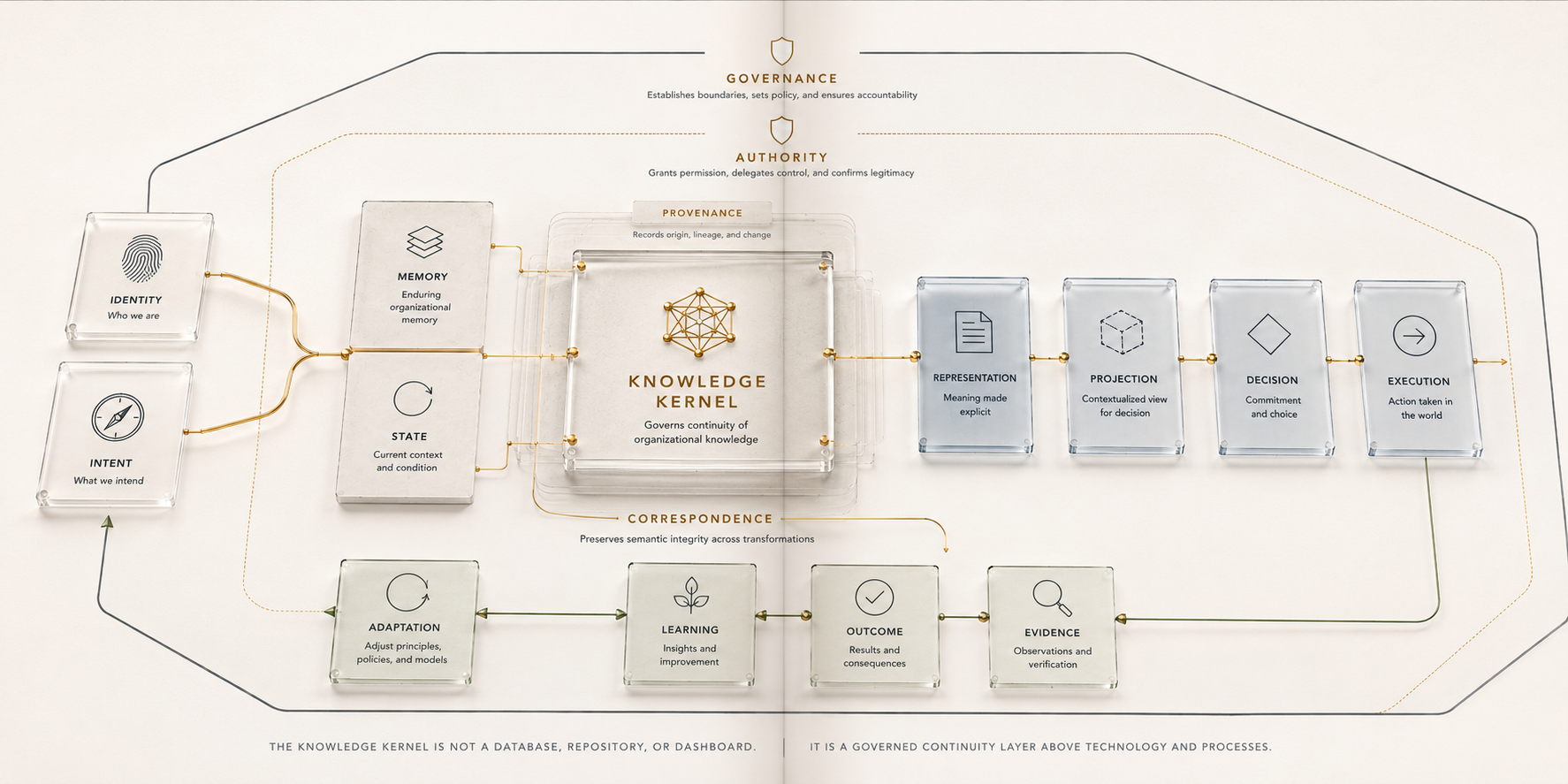
The figure matters because it shows the kernel as a relationship-preserving structure, not a container of information.
The kernel does three essential jobs. First, it preserves identity and intent so that knowledge remains oriented. Second, it preserves source and authority so that projections and recommendations do not become free-floating claims. Third, it preserves lifecycle state so the organization can distinguish current, proposed, contested, stale, superseded, archived, and authoritative knowledge.
The kernel is not useful because it contains one perfect view. It is useful because it can generate many governed views. A board may need a risk projection. A product team may need an execution projection. An AI agent may need a constrained task context. An executive may need a briefing. These views can differ without fragmenting knowledge if they disclose source, scope, authority, freshness, confidence, and contestability.
The Organizational Knowledge Kernel is therefore the first major architecture of the book. But a kernel is only useful if the organization can tell the difference between what it remembers, what is currently true, and what it is projecting for a particular purpose.