Memory, State, and Projection
Three distinctions determine whether organizational knowledge remains usable: memory is not state, state is not projection, and projection is not authority. These distinctions sound abstract until they fail. Then they explain why leaders act on obsolete context, teams follow incompatible summaries, or AI agents operate from a view that was never meant to authorize action.
Organizational Memory retains prior decisions, commitments, evidence, interpretations, outcomes, unresolved matters, dissent, and learning. It allows the organization to remember why something was believed, authorized, rejected, deferred, or revised. But memory is historical and cumulative. It can decay. It can become stale. It can preserve superseded knowledge. It must therefore be governed.
Organizational State is the represented condition of the organization at a point in time. It concerns active commitments, current work, evidence status, decision status, risk, dependencies, and outcomes. State may include historical context, but it is not the same as memory. A decision made six months ago may be part of memory; whether that decision remains active, fulfilled, contradicted, or superseded is a state question.
Projection is a situated expression of governed knowledge for a particular purpose. An executive briefing, board view, team plan, AI explanation, risk summary, or operational status view is a projection. Projection is necessary because no one can use the whole organization at once. But projection becomes dangerous when it hides source, scope, authority, freshness, confidence, or contestability.
The same organizational reality may need three different projections on the same morning: a board-level risk view, an executive decision brief, and a team-level execution plan. The views should differ because the purposes differ. They should not contradict one another about source, authority, lifecycle status, or uncertainty.
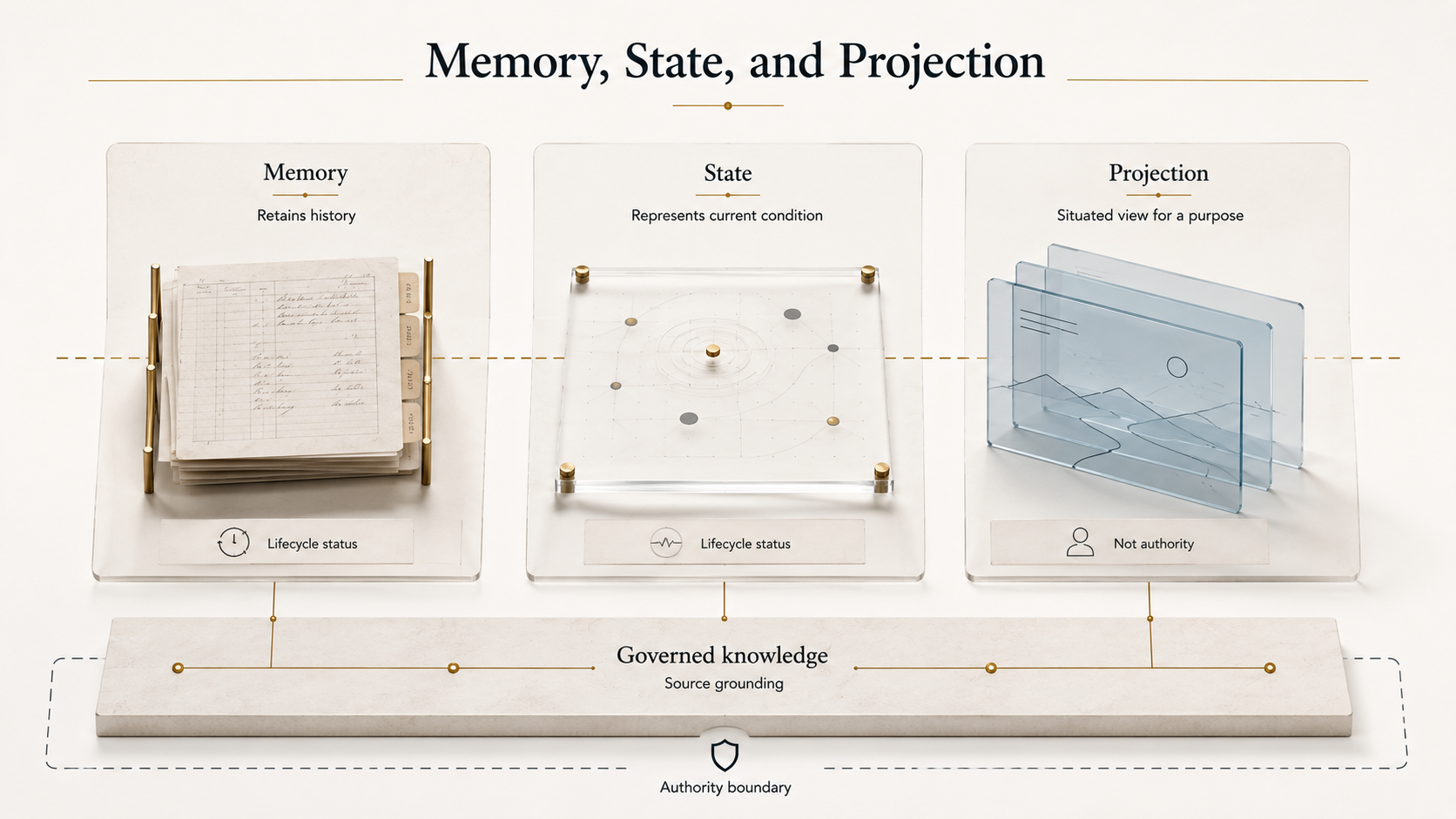
The point is that different views can coexist without becoming different organizational realities.
These distinctions are practical. A leader reviewing an AI-generated summary should be able to ask: Is this memory, current state, or projection? What source does it represent? How fresh is it? What authority does it carry? What is uncertain? What is contested? What action, if any, can legitimately follow?
When these questions are unavailable, projections can fragment the organization. Different teams may act from different summaries. AI agents may use context that appears authoritative but is stale. Executives may treat an interpretation as a decision. The operating system must prevent this by keeping projection tied to governed knowledge.
Knowledge can guide action only when action is legitimate. Once the organization knows what it knows, it must decide who or what can act on that knowledge.