
Execution is not where organizational intelligence ends.
It is where the organization begins to discover whether what it intended, decided, and authorized actually worked.
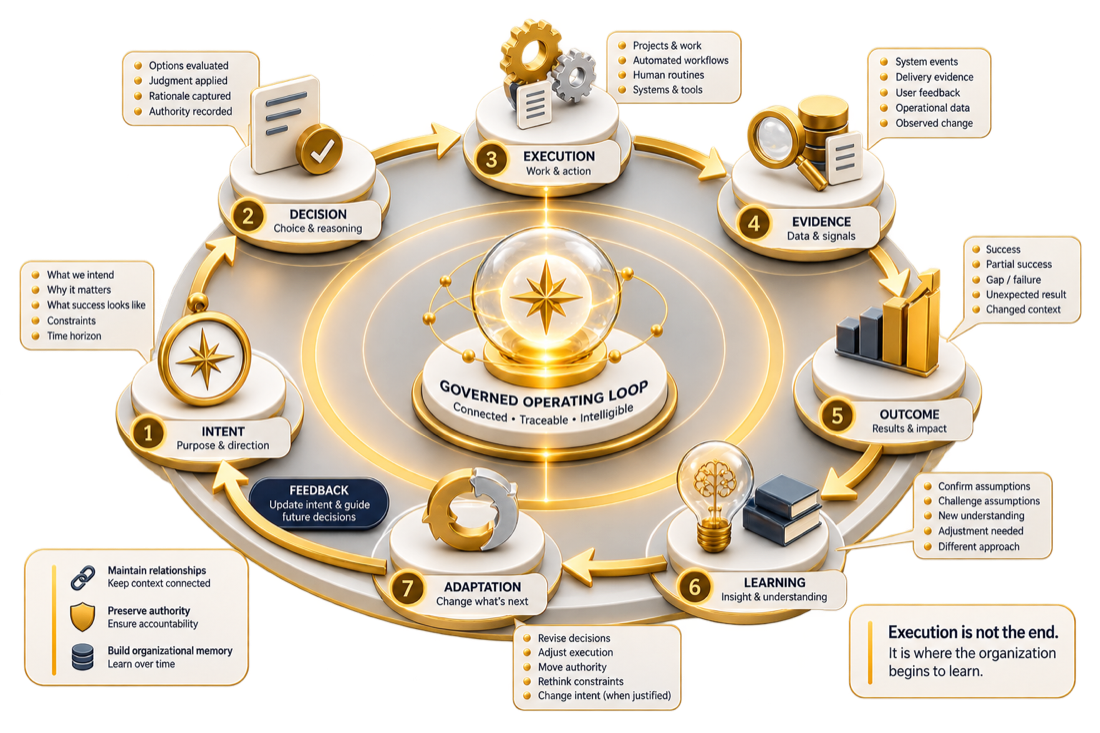
Work produces evidence. Evidence helps the organization understand outcomes. Outcomes create the opportunity to learn. Learning matters when it changes what the organization does next.
How does execution remain connected to the decision?
Once a decision is made, work may move into projects, tickets, repositories, documents, operating tools, automated workflows, or human routines.
Those systems should continue to do what they do well. Organizational Intelligence does not require replacing every system where work happens.
What matters is preserving the relationship between the work and the organizational context that caused it: what was intended, what was decided, who had authority, and what the action was expected to achieve.
Without that continuity, work can be completed successfully while its organizational meaning disappears.
What returns from action?
Evidence is what returns from execution.
It may include operational data, observed change, delivery evidence, user feedback, implementation records, financial results, system events, or reviewed signals from existing tools.
Evidence becomes organizationally useful when it can be related back to the action that produced it and the decision that action was meant to serve.
That allows the organization to compare:
What did we intend?
What did we decide?
What did we actually do?
What happened?
Without those relationships, execution can be completed without the organization becoming wiser.
When does evidence become an outcome?
Evidence tells the organization what happened.
An outcome requires interpretation against intent.
A change in a metric, a completed project, a customer response, or an operational event does not explain its own significance. The organization still has to ask whether what happened was what it intended to achieve.
That may reveal success. It may expose an incorrect assumption. It may show that execution failed. Or it may reveal that the original intent itself needs to change.
The distinction matters:
Evidence is what happened. Outcome is what what happened means in relation to intent.
When does an outcome become learning?
Learning is not simply information being stored.
It occurs when evidence and interpreted outcomes change organizational understanding.
The organization may learn that an assumption was wrong, that a decision was effective, that a constraint has changed, that authority needs to move, or that a different course of action is now justified.
For that learning to matter, it must remain connected to the context that produced it.
Otherwise, it becomes another report, retrospective, dashboard, or document that future decisions may never encounter.
What makes an organization adaptive?
Adaptation happens when learning changes what comes next.
A decision may be revised. Execution may change. Authority may be adjusted. A constraint may be reconsidered. New evidence may alter the organization's understanding of the situation.
Sometimes the intent itself should change.
This is what closes the operating loop:
Intent shapes decisions. Decisions shape action. Action produces evidence. Evidence reveals outcomes. Outcomes create learning. Learning changes future action—and, when justified, future intent.
An adaptive organization is therefore not one that simply changes quickly.
It is one that can understand why it should change.
- What happens when learning changes the original intent?Explore how organizational intent can remain persistent while still being revised when evidence, outcomes, and learning justify a change in direction.
- How does authority change as the organization learns?See how decision rights, authorization, and accountability can remain explicit when evidence requires the organization to adapt.
- How does the whole operating system stay connected?Explore how intent, knowledge, authority, decisions, execution, evidence, and learning form one governed operating reality.
- How does an organization establish this capability?Explore how an organization can move from fragmented AI adoption toward a working AI-native operating model.