
Permission is not the same as authority.
A person may have access to a system without having authority to make a decision. An AI system may be capable of preparing a recommendation without having authority to approve it. A team may be able to begin work without having the authority to change the intent that work is meant to serve.
As work moves across people, systems, and AI, these distinctions become increasingly important. Organizational Intelligence requires decision rights, authorization, delegation, and accountability to remain visible as work unfolds.
Why does AI make authority more important?
AI can assist with interpretation, analysis, drafting, summarization, recommendation, and preparation. Increasingly, it can also execute actions within defined boundaries.
These capabilities can make an organization faster and more capable. But capability does not itself confer authority.
The organization still needs to know who can decide, who can authorize execution, what may be delegated, what requires human judgment, and where accountability ultimately remains.
That is not bureaucracy for its own sake. It is what allows increasingly autonomous work to remain legitimate and governable.
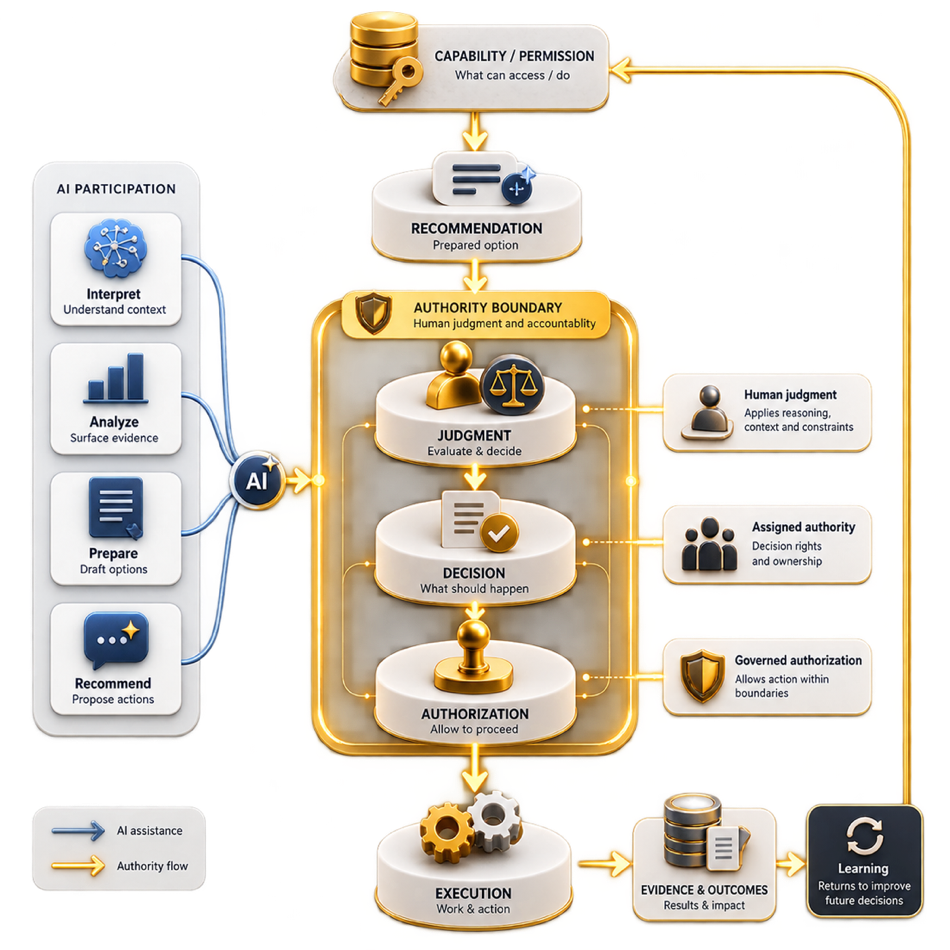
When does a recommendation become a decision?
A recommendation is not a decision.
AI may prepare a recommendation. A team may propose a course of action. A system may surface evidence. But none of these becomes an organizational decision simply because it exists.
A decision becomes organizationally meaningful when the appropriate authority exercises judgment and the organization preserves the rationale, constraints, and ownership attached to that choice.
Authorization is related, but distinct. A decision establishes what should happen. Authorization allows action to proceed under the appropriate authority. Sometimes the two happen together. In other situations, they require separate judgment or review.
The objective is not to slow every action. It is to preserve enough context that execution, evidence, outcomes, and learning can still be traced to the authority and decision that made the action legitimate.
What does governed autonomy look like?
Governed autonomy does not mean a person must approve every action.
It means the organization makes the boundaries explicit: what people, AI, and systems may do independently, what requires review, when authority must escalate, what evidence must be preserved, and who remains accountable for the outcome.
Within those boundaries, AI can interpret context, surface evidence, prepare options, make recommendations, and increasingly execute actions. Beyond them, the appropriate authority remains necessary.
As those boundaries become clearer, autonomy can increase without making authority invisible.
- How do people and AI participate together?See how people and AI can operate within governed boundaries while judgment, authority, and accountability remain explicit where required.
- Where does the authority to act come from?Explore how organizational intent provides the context within which authority, decisions, and subsequent action remain meaningful.
- What happens after a decision is authorized?See how authorized decisions become execution and how evidence remains connected to the authority and reasoning behind them.
- How does the operating system keep all of this connected?Explore how intent, knowledge, authority, decisions, execution, evidence, and learning remain part of one governed operating reality.