
Cognitive Integrity
Organizational Correspondence identifies the emergent property by which meaningful semantic and causal relationships among organizational representations are preserved over time. The second foundational construct of Correspondence Theory names the organizational condition associated with that sustained property. Cognitive Integrity is defined as follows: “Cognitive Integrity is the dynamic organizational condition associated with sustained Organizational Correspondence.”
Figure 3
Dependency Between Organizational Correspondence and Cognitive Integrity
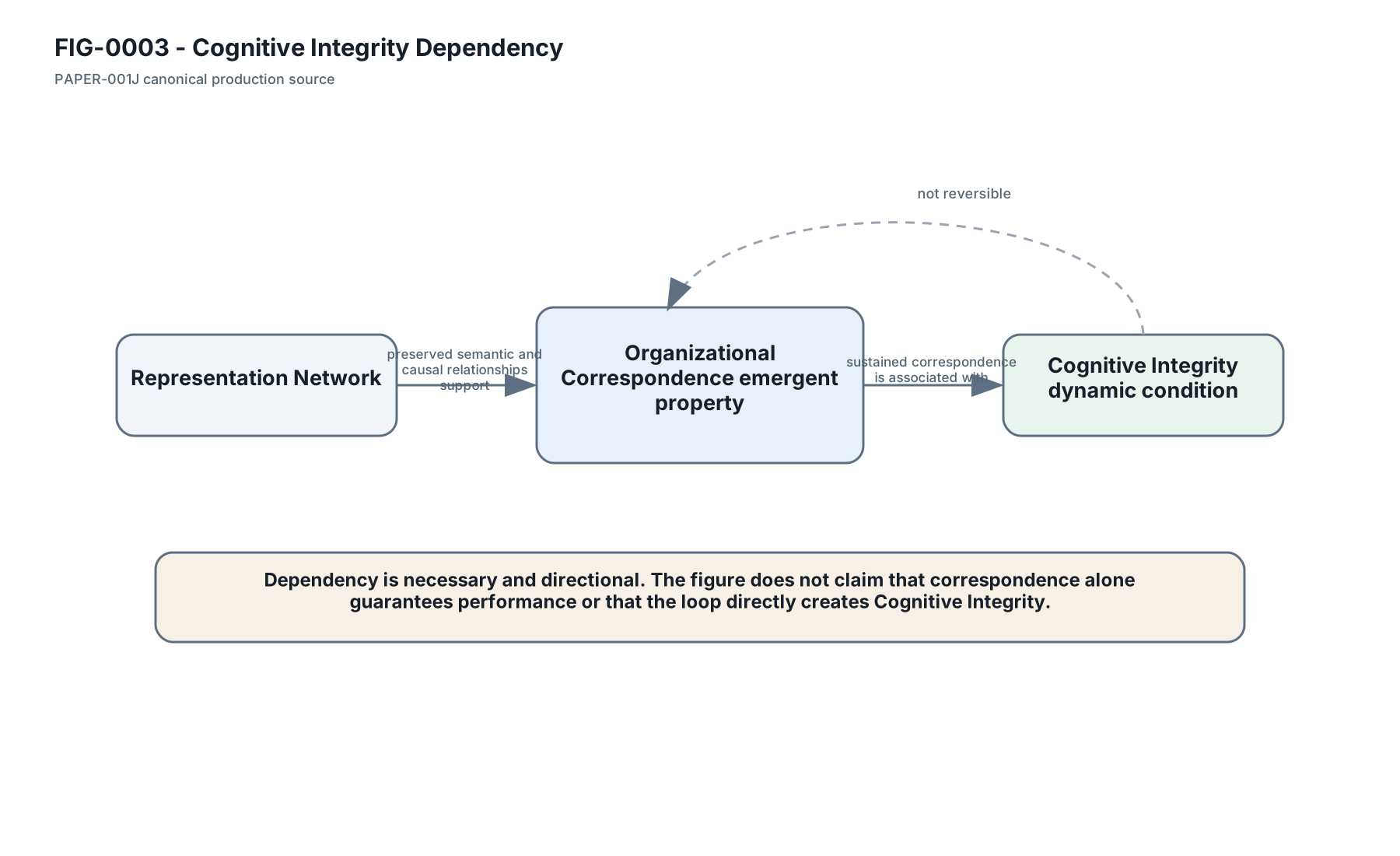
This definition is intentionally concise. It identifies Cognitive Integrity as a condition rather than a mechanism, process, capability, governance practice, performance outcome, or software feature. It also preserves the dependency between the two foundational constructs. Organizational Correspondence is the parent construct. Cognitive Integrity depends on sustained Organizational Correspondence and should not be defined independently of it.
The dependency sequence is:
Representation Network
↓
Organizational Correspondence
↓
Cognitive Integrity
The representation network is the substrate. Organizational Correspondence is the emergent property of that network when meaningful semantic and causal relationships among organizational representations are preserved over time. Cognitive Integrity is the dynamic organizational condition associated with that sustained property. The dependency is not reversible. Organizational Correspondence can be defined without Cognitive Integrity; Cognitive Integrity cannot be defined without Organizational Correspondence.
Cognitive Integrity is an organizational-level construct. It does not describe the mental integrity of an individual actor, nor does it refer to individual rationality, attention, memory, or expertise. It describes the condition of organizational cognition as represented across the organization. This matters because organizations may rely on many competent individuals while still suffering from incoherent organizational cognition. If decisions, policies, plans, outcomes, and memories no longer preserve meaningful semantic and causal relationships, the organization-level condition may degrade even when individual actors remain capable.
Cognitive Integrity is also dynamic. It concerns the condition of organizational cognition as correspondence is sustained, weakened, restored, or degraded over time. The construct therefore differs from static coherence at a single point. An organization may appear coherent in one moment but lose integrity as representations change, decisions accumulate, AI-generated artifacts enter the network, or learning fails to revise relevant relationships. Conversely, an organization may experience local ambiguity or contradiction while preserving broader integrity if those issues are recognized, related, and revised within the representation network.
The construct is emergent because it depends on the sustained preservation of relationships within the representation network. It cannot be reduced to any single document, decision, artifact, actor, system, or governance rule. A well-maintained knowledge repository alone does not establish Cognitive Integrity. Nor does a sophisticated decision process, a strong leadership team, or an advanced AI capability. Cognitive Integrity is associated with the organization-level condition created when the representation network continues to preserve meaningful semantic and causal relationships over time.
This distinction helps explain why organizations can possess many apparently valuable resources while still experiencing cognitive degradation. They may have abundant documentation but weak causal traceability. They may have formal governance but inconsistent interpretation of decisions. They may have advanced analytics but poor connection between analysis, action, outcome, and learning. They may have rapid AI-generated output but insufficient preservation of relationships among that output and the organization's prior representations. In such cases, the issue is not simply absence of information. It is degradation in the condition of organizational cognition associated with weakened Organizational Correspondence.
In the logistics example, Cognitive Integrity declines when the organization can no longer treat the reliability strategy, routing recommendation, operational action, customer complaints, and learning record as a coherent set of related representations. The organization may still possess all of these artifacts, and individual actors may still understand their local tasks. The organization-level condition is weakened because sustained Organizational Correspondence has been interrupted.
Cognitive Integrity should not be confused with performance, dynamic capabilities, strategic alignment, or enterprise-architecture maturity (Ross et al., 2006; Teece et al., 1997; Venkatraman, 1989). High Cognitive Integrity does not guarantee market success, competitive advantage, effective strategy, or operational excellence. Organizations may maintain coherent representations and still choose poorly, face adverse markets, lack resources, or encounter external shocks. Conversely, organizations may perform well for a period despite degraded correspondence. The construct's theoretical purpose is narrower: it describes the condition of organizational cognition associated with sustained Organizational Correspondence. Any relationship to performance remains downstream and requires separate empirical study.
The relationship between Cognitive Integrity and the Correspondence Loop must also remain precise. The Correspondence Loop does not directly create Cognitive Integrity. It recursively maintains the organizational representation network. That maintenance preserves or restores the conditions from which Organizational Correspondence emerges. Sustained Organizational Correspondence is associated with Cognitive Integrity. This separation keeps the theory architecturally clean: the representation network is the substrate, Organizational Correspondence is the emergent property, Cognitive Integrity is the dynamic condition, and the Correspondence Loop is the mechanism that maintains the representation-network conditions under which the constructs are sustained.
Cognitive Integrity is independent of any specific technical or organizational form. AI may increase an organization's capacity to generate representations, but a larger volume of representations does not itself imply higher Cognitive Integrity. The relevant question is whether those representations remain connected to intent, decisions, policies, outcomes, and memory. Cognitive Integrity is not directly observed. It is inferred from evidence concerning representation-network conditions, Organizational Correspondence, and the activities that preserve or degrade correspondence over time. This preserves the distinction between theory and later research methodology.
Cognitive Integrity therefore gives Correspondence Theory its second foundational layer. Organizational Correspondence explains the emergent property that must be preserved. Cognitive Integrity explains the dynamic organizational condition associated with that sustained property. The remaining theoretical task is to explain how organizations maintain, degrade, revise, or restore the representation-network conditions under which these constructs are sustained. That task belongs to the Correspondence Loop.