
Operating Mechanisms
The model becomes explanatory through mechanisms. Representation formation (M01) transforms organizational traces into structured projections. Correspondence assessment (M02) evaluates whether those projections remain fresh, grounded, complete enough, and non-contested enough for executive use. Anomaly and tension detection (M03) identifies changes, conflicts, or unexpected patterns. Intent-based relevance (M04) relates those signals to current organizational intent. Executive attention formation (M05) selects awareness candidates according to intent, consequence, uncertainty, reversibility, dependency, and authority.
Contextual compression (M06) produces briefings that reduce cognitive burden without hiding evidence, uncertainty, or decision boundaries. Evidence disclosure (M07) makes support inspectable at progressive levels. Uncertainty communication (M08) keeps confidence, freshness, ambiguity, conflict, and unknowns explicit. Conversational grounding (M09) binds inquiry and discussion to structured organizational objects rather than free-floating chat. Recommendation formation (M10) proposes interpretations or courses of action grounded in evidence and bounded by uncertainty. Contestation (M11) allows executives or other authorized participants to challenge representations, recommendations, evidence, or assumptions.
Decision formation (M12) converts understanding into human or collective commitment. Authority gating (M13) tests whether the actor or body has rights to authorize the relevant organizational change. Action execution (M14) initiates or records authorized change while preserving traceability. Outcome capture (M15) records effects. Memory consolidation (M16) retains rationale, evidence, unresolved matters, dissent, and outcomes. Learning propagation (M17) updates future representations, priorities, practices, or governance rules when outcome comparison warrants change.
Figure 4 visualizes the state-to-attention-to-action mechanism chain.
<a id="fig-4"></a>
Figure 4
State-to-Attention-to-Action Mechanism Chain
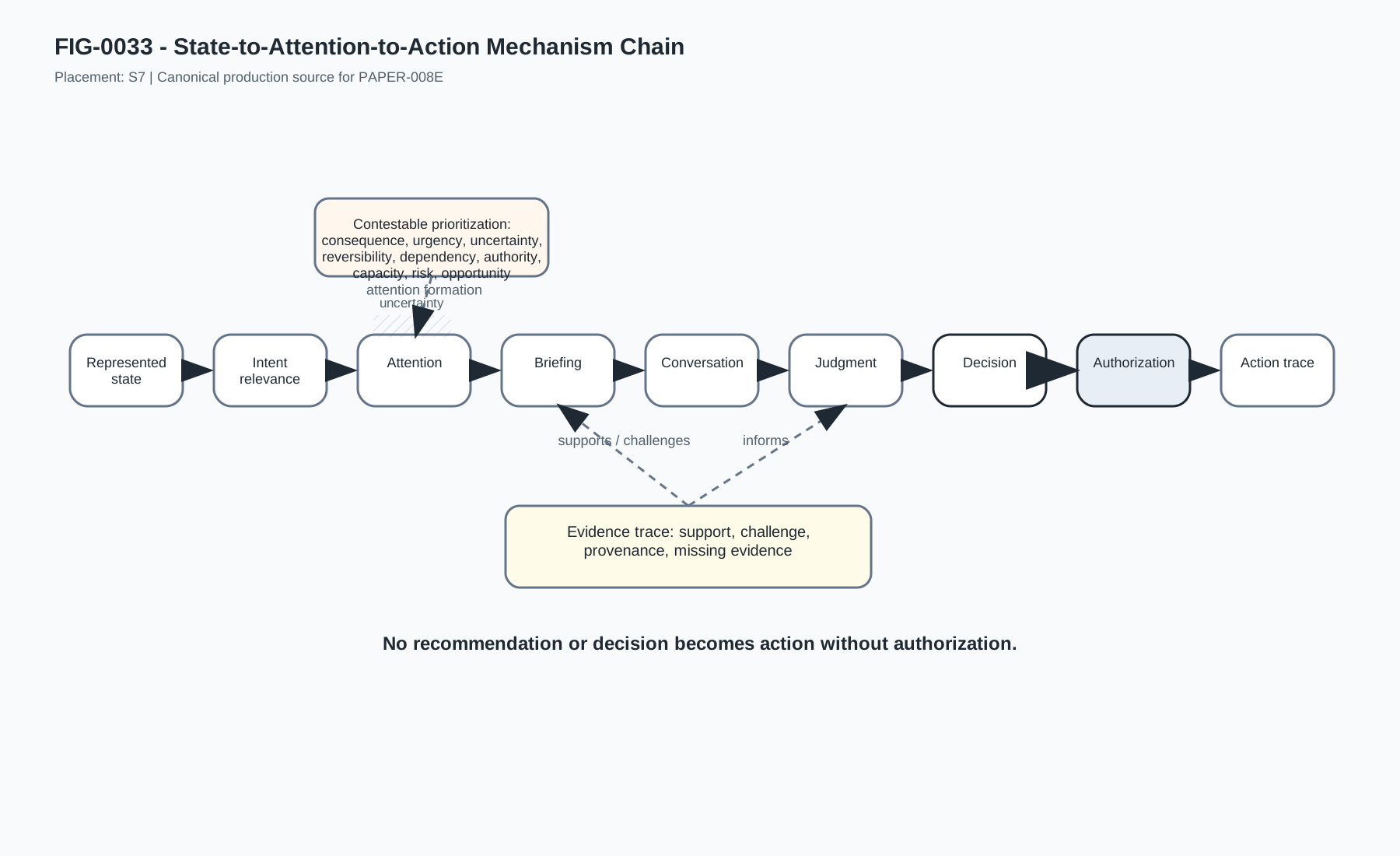
Long description: see `figures/FIG-0033/accessibility.md`.
Table 4, Mechanism Summary, summarizes mechanism families by inputs, transitions, outputs, and failure modes.
<a id="table-4"></a>
Table 4. Mechanism Summary
| Mechanism family | Inputs | Transition | Outputs | Failure mode |
|---|---|---|---|---|
| Representation and correspondence | Source records, intent, context, time. | Conditions become structured representations and correspondence assessments. | Represented state, drift/tension account. | Missing context, stale representation, false coherence. |
| Attention and briefing | Interpretation, executive context, consequence, uncertainty. | Relevant conditions become prioritized attention items and compressed briefings. | Attention item, briefing summary. | Overload, agenda capture, hidden low-frequency risk. |
| Evidence and uncertainty | Claim, evidence, provenance, confidence, missingness. | Support is progressively disclosed and limits are made explicit. | Evidence view, uncertainty statement. | Evidence dumping, fabricated support, false certainty. |
| Conversation and contestation | Briefing, structured objects, participant acts. | Conversation grounds references, challenges claims and repairs ambiguity. | Grounded conversational state, revised claim or recommendation. | Ambiguity, groupthink, deference. |
| Recommendation and decision | Interpretation, evidence, alternatives, authority context. | Recommendation is formed and judged by authorized humans or bodies. | Recommendation, decision record. | Automation bias, premature decision. |
| Authority and execution | Decision, role, rights, delegation, risk. | Authority is checked before action is authorized or escalated. | Authorization, execution trace. | Unauthorized action, hidden change. |
| Outcome and learning | Execution trace, expected outcome, evidence, memory. | Outcomes are captured, compared and converted into memory or learning candidates. | Outcome record, operating memory, learning update. | Outcome blindness, institutionalized error. |
The mechanisms clarify why EOE cannot be evaluated merely by asking whether information was shown or whether a conversation occurred. Effects depend on transition quality. A representation may be available but not correspond to reality. A briefing may be concise but hide uncertainty. A recommendation may be plausible but lack evidence. A decision may be recorded but not authorized. A memory may be retained but preserve error. Each transition creates both possibility and failure risk.
The mechanisms also distinguish theory from design implication. The theory states that executive operating episodes require these transitions to preserve meaning and authority. It does not claim that any particular interface pattern or implementation technique will necessarily produce them. That empirical question belongs to the evaluation agenda developed later in the paper.
The mechanism chain further clarifies why executive operating experiences must handle interruption and repair. Executives may challenge the relevance of an attention item, request deeper evidence, contest a source, defer a decision, escalate authority, or ask how a recommendation would affect existing commitments. These interruptions are not deviations from the operating episode; they are part of how correspondence is maintained. A system that treats challenge as friction may optimize for fluency while weakening understanding. Conversely, an EOE that supports repair can slow a moment of action while protecting the legitimacy of what follows.
The same chain identifies important interaction failure modes. AI prioritization can capture the agenda if relevance criteria are hidden. Progressive disclosure can become evidence overload if every claim demands inspection. Explanation can produce fatigue if it repeats generic rationale rather than answering the executive's question. Confidence displays can produce overreliance if they are not paired with evidence and uncertainty. Interruption can become costly if repair paths fragment the briefing. These are not peripheral usability concerns; they are mechanism failures because they weaken the transition from represented state to legitimate executive action.