
Organizational Correspondence
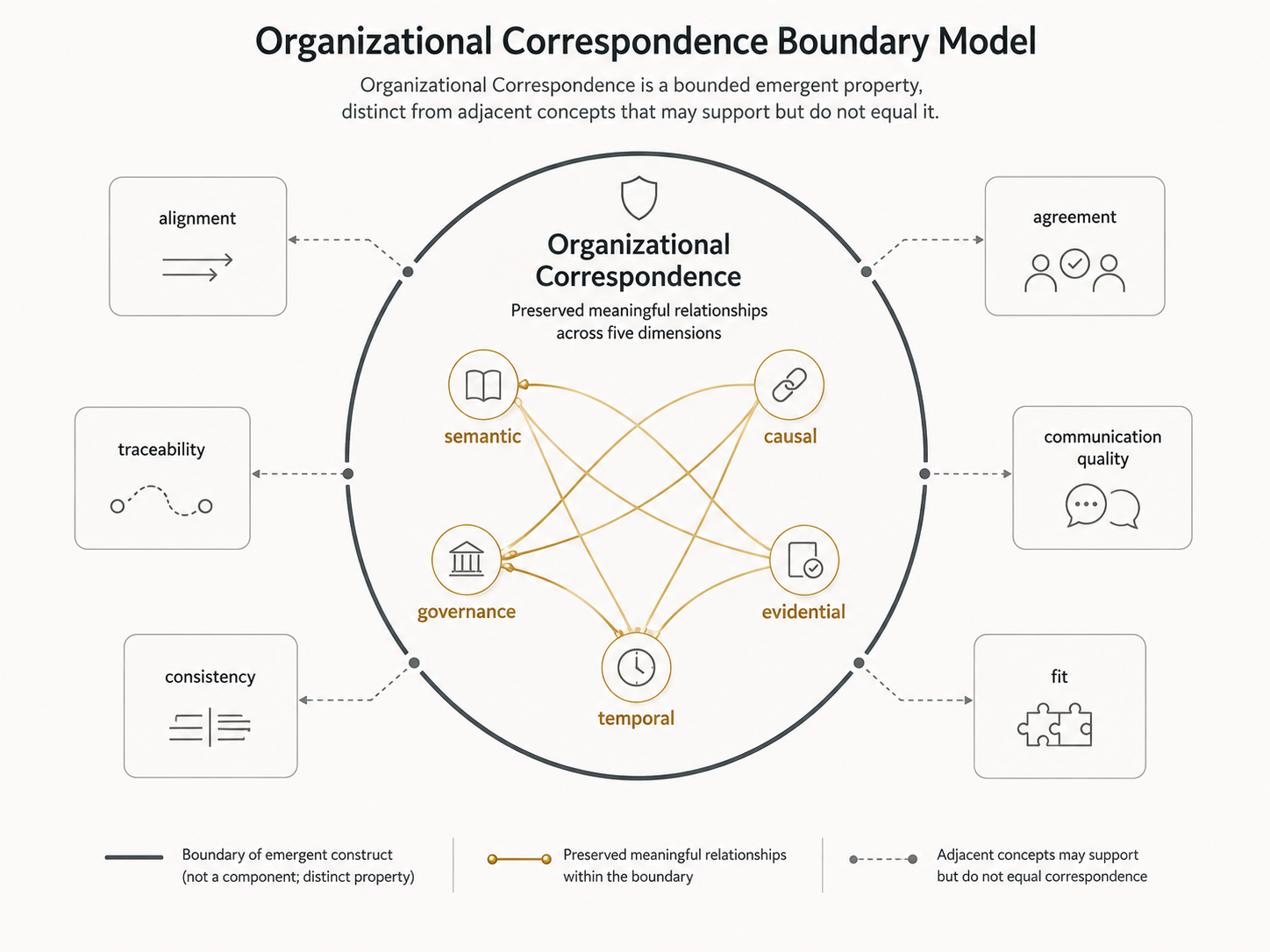
The theory's central construct is Organizational Correspondence: the emergent organizational property by which meaningful semantic, causal, evidential, temporal, and governance relationships among organizational representations are preserved over time. The precision of this definition matters. Organizational Correspondence is emergent because it does not reside in any single representation. A strategy, decision record, model, policy, AI output, or outcome report may be internally coherent while still weakening correspondence if it fails to preserve its relationships to the wider network. Correspondence arises from the condition of the network.
It is organizational because it concerns represented cognition at the organization level. Individuals may understand their local work, teams may share assumptions, and systems may store accurate data, but the organization can still lose correspondence if relationships among its representations degrade across boundaries. Organizational Correspondence is therefore not individual understanding, team agreement, local coordination, or system consistency.
It is dynamic because Organizational Correspondence concerns preservation over time. Organizations continuously create, revise, transform, retire, and reinterpret representations. Organizational Correspondence is not perfect agreement at a single moment. It is the preservation of meaningful relationships as the Representation Network changes.
The construct is narrower than alignment. Alignment usually concerns fit among strategy, structures, incentives, resources, activities, or goals. Organizational Correspondence concerns the meaningful relationships among representations. An organization may be broadly aligned while losing correspondence among the artifacts that explain how intent becomes decision, action, evidence, outcome, memory, and learning. Conversely, correspondence does not imply that all actors agree or that all goals are compatible. It means the relationships among representations remain intelligible and reviewable.
Organizational Correspondence is also distinct from traceability. Traceability can help review correspondence, but traceability alone is not correspondence. A chain of links may exist while meaning changes, evidence weakens, authority expires, or causal assumptions become invalid. Correspondence requires relationship preservation, not merely link preservation.
The recurring chain makes the distinction visible. If the lesson links back to the outcome, the outcome links back to the execution record, and the execution record links back to the decision, the organization has traceability. It has correspondence only if those links still preserve the right meaning, cause, evidence, time, and authority.
Correspondence Preservation names the maintenance, revision, restoration, or governed acceptance of the relationships required for Organizational Correspondence. The term is important because preservation does not always mean keeping a relationship unchanged. In some cases, preservation requires revision because evidence has changed, authority has expired, meaning has shifted, or a representation has been superseded. In other cases, preservation requires an organization to accept a known limitation and make that limitation visible. Correspondence Preservation is therefore dynamic: it keeps the Representation Network meaningful by governing how relationships endure, change, or are qualified.
After this chapter, the book sometimes uses `correspondence` as shorthand for Organizational Correspondence or for relationship preservation within the theory. The shorthand should not be read as generic fit, agreement, communication quality, alignment, or consistency.
Correspondence can degrade. Semantic degradation occurs when representations use the same language while meanings diverge. Causal degradation occurs when representations lose their relationship to decisions, actions, or outcomes. Evidential degradation occurs when claims become detached from support, challenge, or uncertainty. Temporal degradation occurs when old representations appear current or current representations lose their history. Governance degradation occurs when authority, accountability, or revision conditions become unclear.
These forms of degradation explain why an organization can appear information-rich yet cognitively incoherent. Correspondence Theory therefore places Organizational Correspondence at the center of intelligent organization. The next question is what organization-level condition becomes possible when correspondence is sustained. That condition is Cognitive Integrity.