
From Assessment to Measurement
Measurement is necessary because scientific theory eventually requires operationalization. Without measurement, Correspondence Theory would remain limited to conceptual judgment and qualitative assessment. Measurement is also risky because correspondence is relational, multi-level, temporal, evidence-dependent, and governance-sensitive. A careless measure can distort the construct it claims to operationalize.
The transition from assessment to measurement therefore begins with a warning: measurement is not assessment. Assessment asks what warranted judgment can be made about correspondence state in a bounded context. Measurement asks how some theoretically specified property of correspondence can be systematically operationalized through explicit objects, units, evidence, observations, inferences, procedures, results, profiles, uncertainty, and permitted uses.
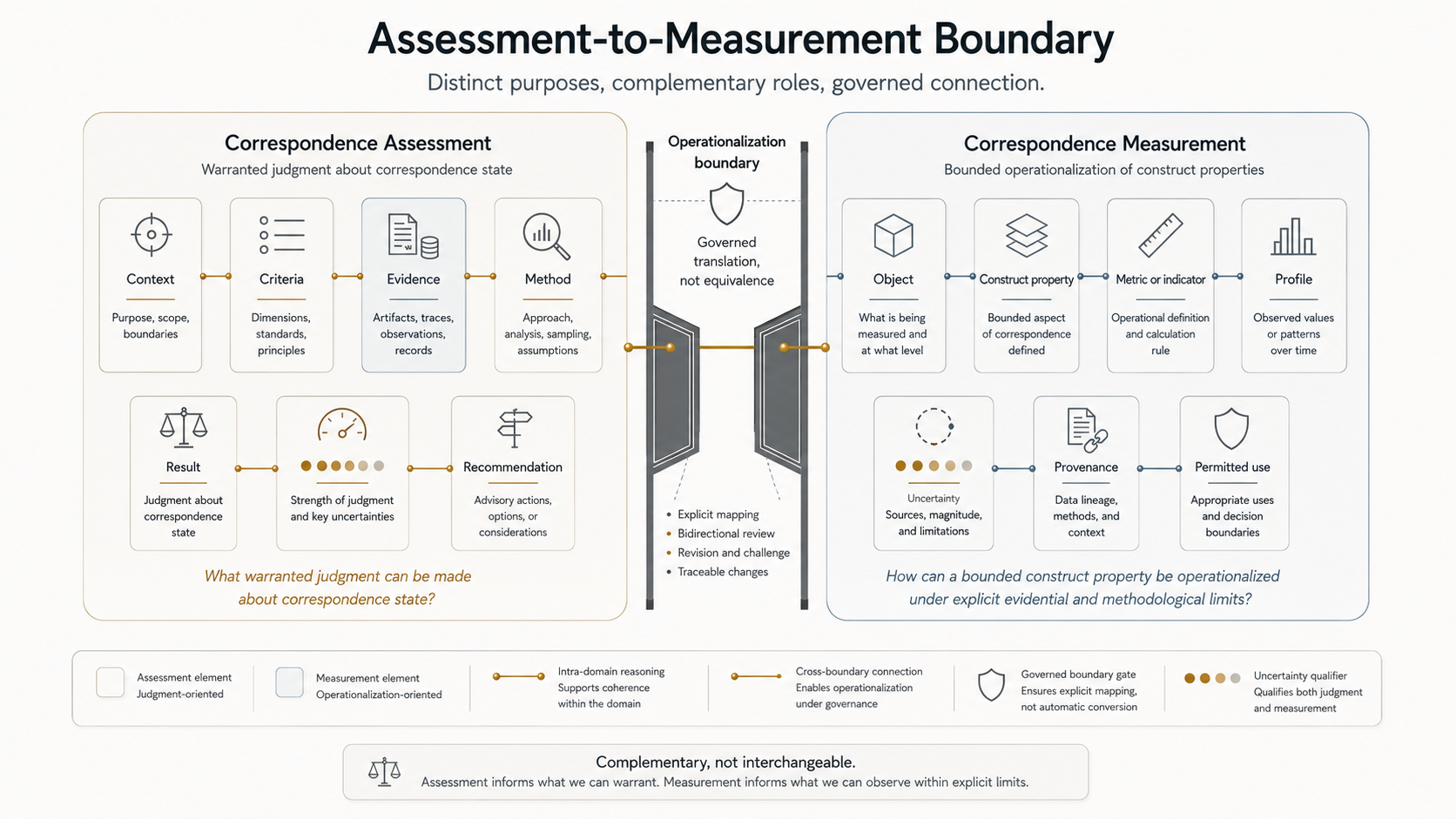
Measurement is also not diagnosis. Diagnosis interprets causes, severity, and possible remedies. Measurement may support diagnosis, but it does not by itself explain why correspondence is degraded or what should be done. Measurement is not recommendation. Recommendation is advisory interpretation for possible action. Measurement is not governance. Governance decides what claims may be used, who may act, and under what authority.
The measurement problem is thus exacting. A measurement result must specify what correspondence property is being measured, in which representation network, at what level, over what period, using what evidence, through what procedure, with what inference, under what uncertainty, for what permitted interpretation. Without these boundaries, measurement becomes dashboard production rather than construct operationalization.
A simple thought experiment shows the risk. Suppose an organization reports that 90 percent of strategic decisions link to evidence records. That may be a useful measure of trace coverage. It does not by itself measure whether the evidence still supports the decision, whether the authority condition remains valid, whether later outcomes changed the claim, or whether the measure may be interpreted at the organizational level.
Correspondence Theory therefore treats measurement as downstream of theory and assessment. Theory defines the construct. Assessment clarifies the judgment problem. Measurement operationalizes bounded properties of the construct without claiming more than its evidence and method can support.