
Measuring Correspondence
Correspondence Measurement is the systematic, construct-grounded, relational, multi-level, evidence-based, temporally explicit, and uncertainty-aware operationalization of Organizational Correspondence. The definition preserves the theory's boundaries. Measurement is construct-grounded because it begins from Organizational Correspondence, not from available data. It is relational because correspondence concerns relationships among representations. It is multi-level because evidence may support claims at the level of a representation pair, pathway, network region, initiative, function, or organization, while cross-level claims require explicit logic. It is evidence-based because measurement depends on identifiable support and challenge. It is temporally explicit because correspondence may change across time. It is uncertainty-aware because measurement results require warrant qualifiers.
A Correspondence Measurement Instance is the bounded record of a measurement execution. It should specify the measurement identity, object, construct property, level, unit, context, temporal frame, evidence, observation, inference, procedure, result, profile, uncertainty, provenance, limitations, review status, and permitted use. This instance architecture prevents measurement from becoming a free-floating number.
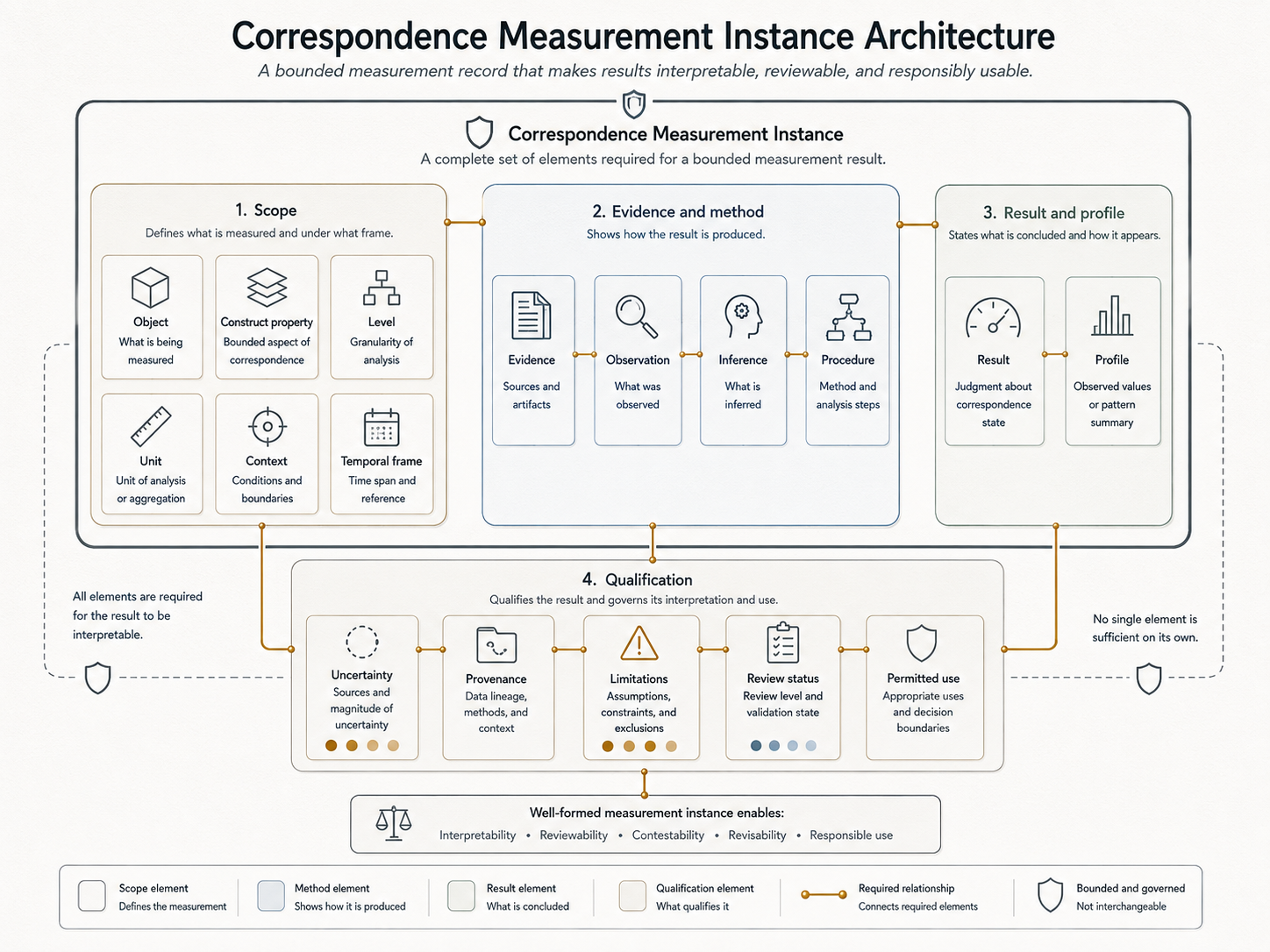
The measurement object may be a relationship, pathway, network region, transformation sequence, decision chain, evidence chain, governance relation, memory relation, temporal preservation condition, or AI-generated representation pathway. The unit may be a representation pair, claim, decision, event, relationship type, network segment, initiative, or organizational domain. The level must be specified because local correspondence cannot be averaged into organizational correspondence by default.
Evidence may include documents, records, traces, interviews, logs, decision histories, governance artifacts, memory entries, AI outputs, outcome data, or observed contradictions. Evidence must be admissible for the claim. A trace may show that a link exists without showing that the semantic relation remains valid. A timestamp may show sequence without showing causal preservation. A metric may show activity without showing correspondence.
This is why the same observable material can play different roles. A log may be evidence of sequence, but not evidence of meaning. A citation may be evidence of source, but not evidence of authority. A model output may be evidence of classification, but not evidence that the organization may act on the classification without further judgment.
The measurement result should therefore be interpreted as a bounded result, not a universal score. It may describe coverage, continuity, traceability, contradiction, drift, recovery, uncertainty, or preservation for a specified object under specified conditions. The result may support assessment, but it does not replace assessment.