Metrics, Profiles, Aggregation, and Time
Measurement requires disciplined distinctions among measures, metrics, indicators, profiles, and indices. A measure is an observed or derived value for a specified object under a specified procedure. A metric is a governed, reusable specification for producing such values. An indicator is an interpretation-bearing signal derived from one or more measures or metrics. A profile is a structured collection of non-equivalent measures or indicators. An index is an aggregated composite representation that requires explicit validity, weighting, normalization, compensability, and interpretation assumptions.
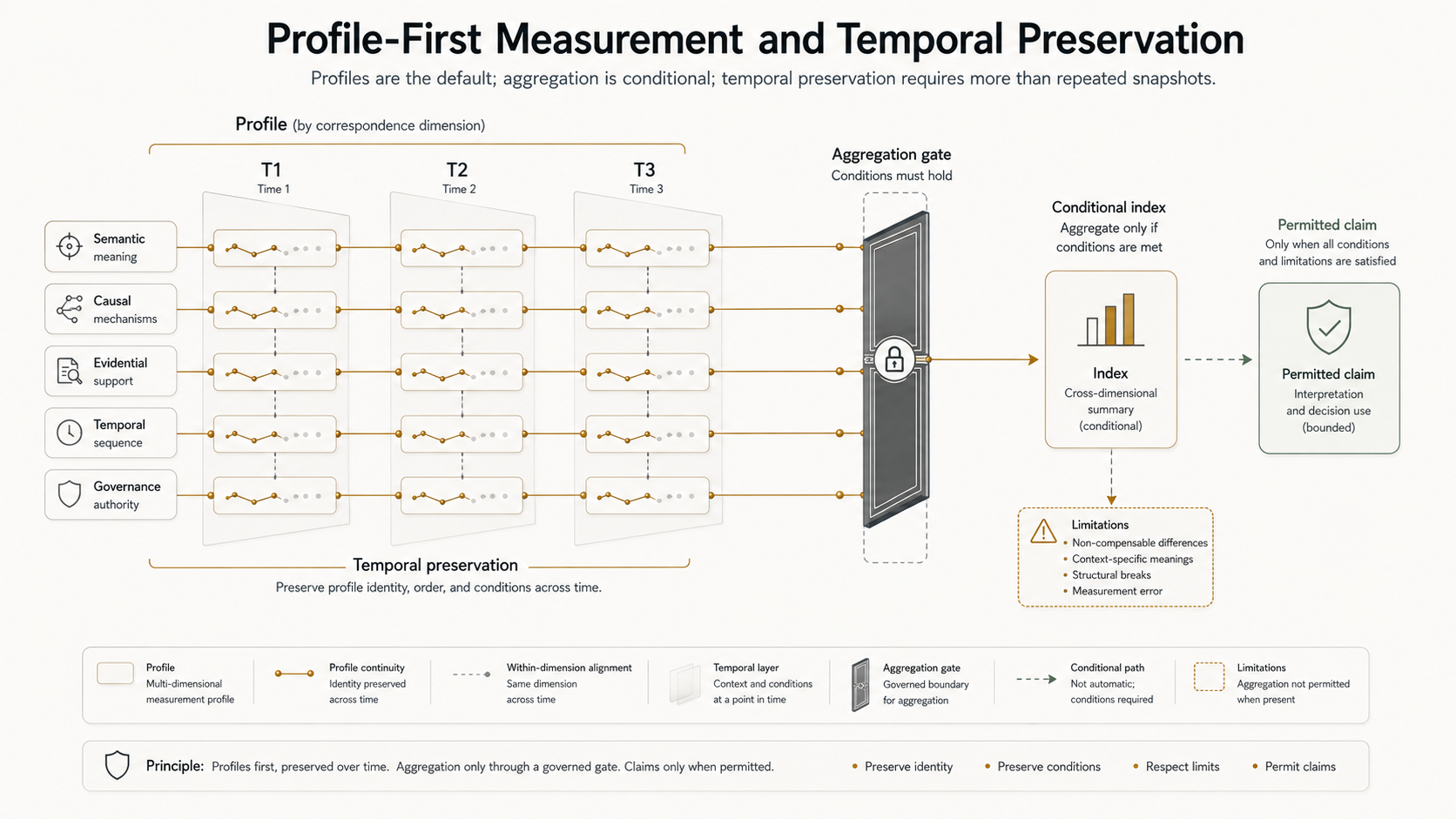
Correspondence Measurement should be profile-first. Organizational Correspondence is not a single latent trait that can responsibly be inferred from any convenient set of indicators. Different correspondence properties may not compensate for one another. Strong traceability from intent to decision may not compensate for an unsupported outcome claim. High semantic continuity may not compensate for expired authority. Good coverage may not compensate for unresolved contradiction.
Aggregation is therefore conditional rather than default. Aggregation may be admissible only when the measured properties are compatible, level relations are theoretically defensible, evidence warrants are preserved, non- compensability risks are visible, and sensitivity, robustness, invariance, and interpretive boundaries are tested. A blocked aggregation path does not mean low correspondence; it means the aggregation claim is invalid.
Time further complicates measurement. A representation relationship may be valid at one moment and invalid later. Evidence may support an outcome claim within one validity interval and become stale after conditions change. Measurement must distinguish state, transition, drift, recovery, and preservation. It must specify execution time, validity interval, comparison period, and procedure version where relevant.
Temporal measurement is especially important because correspondence is about preservation over time. A static snapshot may show consistency without showing whether relationships are maintained through revision. A longitudinal profile can show whether correspondence is sustained, weakened, restored, or transformed as organizational cognition evolves.