
Methodological Assurance and Claim Permission
Methodological assurance defines what Correspondence Measurement results may responsibly claim. Validity is the central requirement. A measurement is valid when the interpretation and use of the result are justified for the construct claim being made. Reliability is necessary but not sufficient; a consistently produced result can still measure the wrong property. Traceability is necessary but not sufficient; a complete trace can still preserve a distorted relationship. Coverage is necessary for many claims, but it does not itself establish construct validity.
Correspondence Measurement requires assurance across validity, reliability, calibration, sensitivity, robustness, traceability, reproducibility, comparability, invariance, contestability, uncertainty, validation status, and permitted use. These are not bureaucratic additions. They are safeguards against false precision.
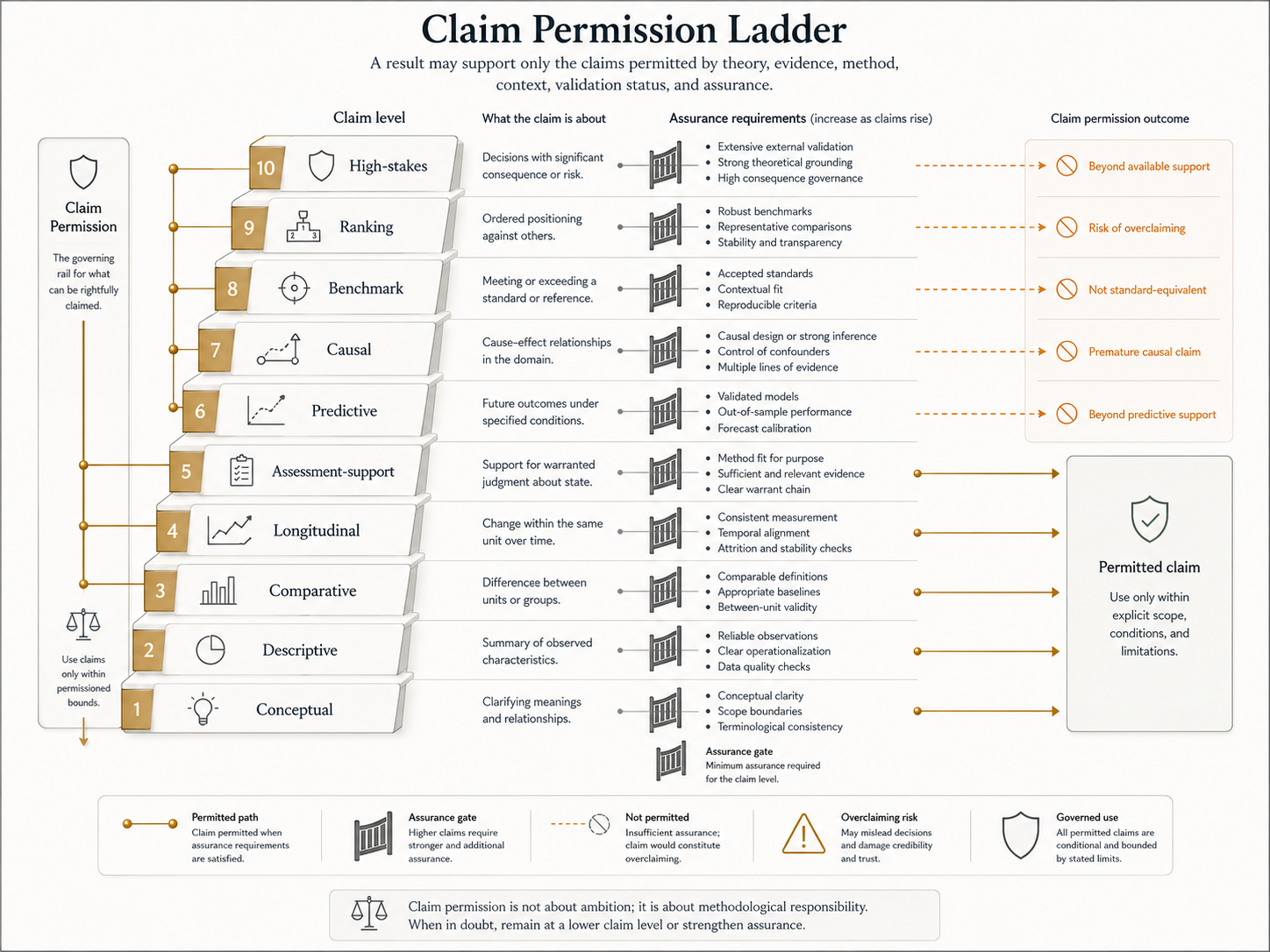
Claim Permission is the boundary specifying what a result may and may not support. It creates a ladder of methodological maturity. Conceptual claims may be made when theory supports them. Descriptive claims require bounded evidence and explicit procedure. Comparative claims require comparability and invariance evidence. Longitudinal claims require temporal comparability and procedure-version control. Assessment-support claims require clear distinction between measurement and judgment. Predictive, causal, benchmark, ranking, or high-stakes governance claims require additional empirical validation and governance authorization.
This ladder does not imply that every measurement should progress toward ranking or prediction. Many correspondence questions are best answered through profiles, trajectories, configurations, or bounded claims. The purpose of assurance is not to make measurement more elaborate than necessary. It is to prevent measurement from claiming more than the construct, evidence, method, and context permit.
Methodological assurance also bounds AI-assisted measurement. AI may assist coding, extraction, relationship detection, summarization, inference, and anomaly identification. Its role must be labeled. Its outputs require provenance, calibration, reviewability, contestability, and uncertainty. Model confidence is not measurement confidence. Automated inference is not validated interpretation.
With assurance in place, Correspondence Theory can state its proposition architecture without presenting theoretical expectations as established empirical findings. That discipline prepares the final part of the book: a research program that treats the theory as testable, revisable, and bounded.
Part VI turns the book back toward science. Once the theory has defined its construct, architecture, assessment logic, and measurement boundaries, the remaining task is to state what can be proposed, tested, qualified, and extended without turning conceptual coherence into premature empirical certainty.