
Proposition Architecture and Boundary Conditions
The propositions of Correspondence Theory express theoretical expectations derived from the construct architecture. They are not empirical findings, validated laws, or universal prescriptions. They define a research program.
The first proposition family concerns Representation Networks. Higher-quality representation-network maintenance is expected to be associated with stronger Organizational Correspondence. Representation-network degradation is expected to accumulate when semantic, causal, evidential, temporal, or governance relationships are not preserved. Increasing representational complexity without corresponding maintenance capacity is expected to increase correspondence degradation risk.
The second proposition family concerns the Correspondence Loop. More frequent meaningful representation-network change is expected to increase the need for Correspondence Loop activation. Stronger mechanism readiness is expected to improve recovery from degradation. Successful Correspondence Revision is expected to reduce accumulated degradation within the affected region of the network.
The third proposition family concerns Organizational Correspondence and Cognitive Integrity. Higher Organizational Correspondence is expected to be associated with higher Cognitive Integrity. Representation-network degradation is expected to precede observable declines in Cognitive Integrity. Organizations with similar resources, strategies, and formal governance may exhibit different levels of Cognitive Integrity because of differences in representation-network maintenance.
The fourth proposition family concerns Correspondence Architecture. Organizations with stronger preservation architecture are expected to preserve correspondence more effectively across representation change. Canonical organizational objects are expected to support semantic consistency across multiple representations. Organizational Memory is expected to mediate the relationship between correspondence preservation and future adaptation by making prior represented cognition reusable. Architectural traceability is expected to improve governance quality by making reasons, evidence, authority, and revision pathways reviewable.
The fifth proposition family concerns assessment and measurement. Correspondence Assessment is expected to produce more warranted judgments when context, subject, criteria, evidence, method, confidence, and traceability are explicit. Correspondence Measurement results are expected to be interpretable only when object, level, unit, temporal frame, evidence, procedure, uncertainty, and permitted use are specified. Profile-first measurement is expected to preserve construct validity better than premature aggregation when correspondence properties are non-equivalent.
The sixth proposition family concerns AI-native organizations. AI-generated representation volume is expected to increase correspondence-maintenance demands. AI systems are expected to improve represented organizational cognition only when their outputs remain connected to intent, evidence, authority, decisions, outcomes, memory, and learning. AI-assisted assessment or measurement is expected to be more reliable when provenance, uncertainty, reviewability, and contestability are preserved.
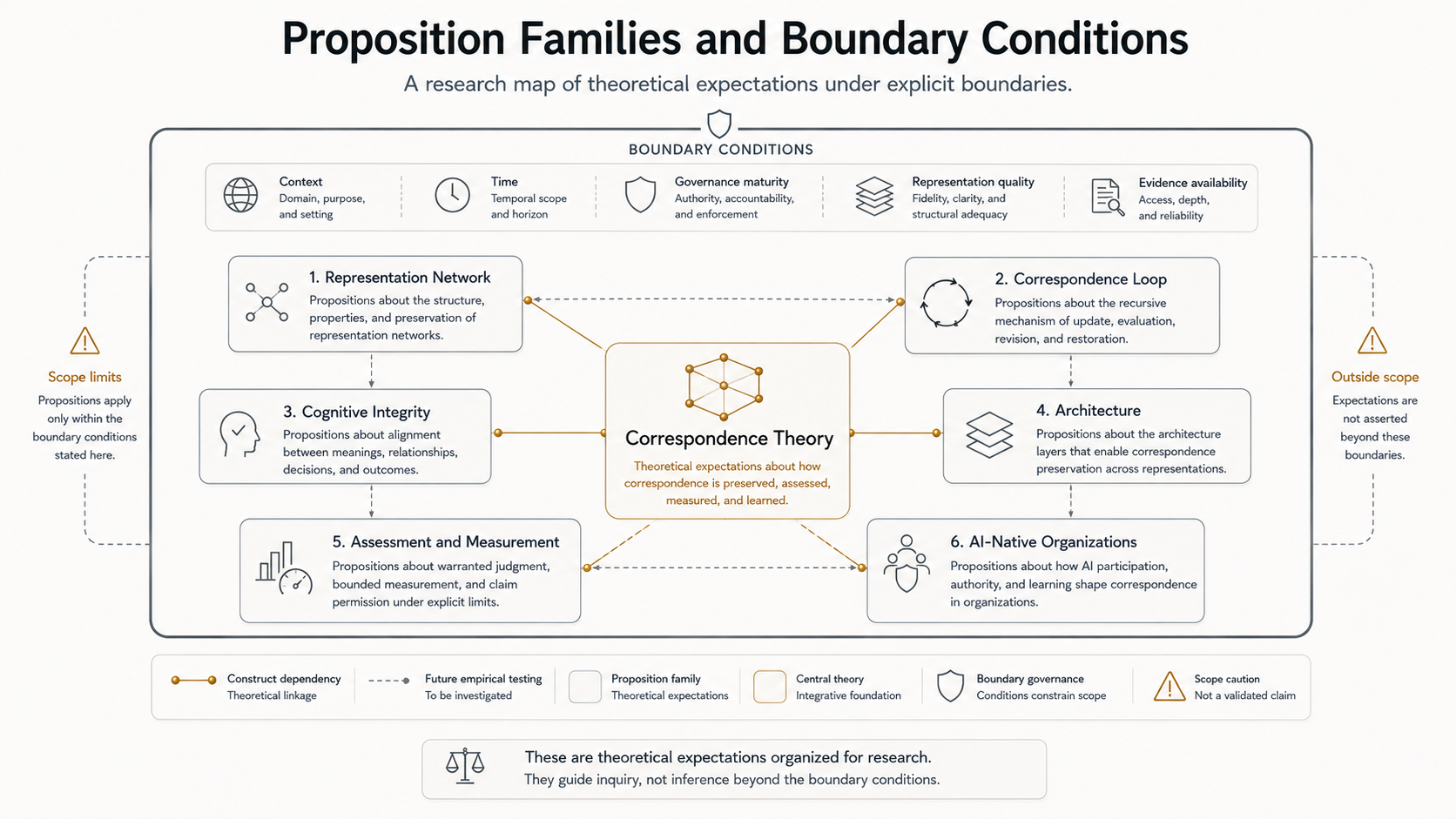
Boundary conditions are equally important. Correspondence Theory applies most directly where organizations depend on persistent representations and meaningful relationships among them. It is less explanatory in settings where organizational action is minimally represented, where relationships among representations are irrelevant to the phenomenon under study, or where performance is dominated by external shocks unrelated to represented cognition. The theory also does not claim that correspondence is always beneficial. Excessive preservation of obsolete relationships may inhibit necessary change; governance must distinguish preservation from rigidity.
The boundary is not a weakness of the theory. It is what makes the theory usable. A theory that claims to explain every form of organizational success or failure cannot guide careful assessment. Correspondence Theory becomes stronger when it states precisely what kind of coherence it explains and what conditions remain outside its explanatory center.