
The Residual Gap in Organization Theory
Existing theories explain essential parts of organizational cognition. Organizational information-processing theory explains how organizations manage uncertainty and equivocality through information structures. Learning theory explains how experience changes knowledge, routines, and behavior. Organizational memory explains retention, storage, retrieval, and reuse. Sensemaking explains interpretation under ambiguity. Distributed cognition shows that cognition can be distributed across people, artifacts, and environments. Systems theory and cybernetics explain feedback, regulation, and adaptation. Dynamic capabilities explain sensing, seizing, and transforming. Sociotechnical and digital-organization theories explain how technology and organizing shape one another.
Correspondence Theory depends on these foundations. It does not deny that organizations process information, learn, remember, coordinate, interpret, adapt, or govern. It asks why these activities can coexist with fragmentation in represented cognition. An organization may learn locally while failing to connect the lesson to future decisions. It may remember extensively while retaining obsolete or disconnected representations. It may coordinate efficiently around work whose relationship to intent has weakened. It may deploy AI governance while leaving AI-generated representations detached from evidence, authority, and memory.
The residual gap is therefore not that existing theories are wrong. It is that they do not fully explain how meaningful relationships among persistent organizational representations are preserved across time. Learning explains change in knowledge; correspondence asks whether the learned representation remains connected to the decisions and outcomes that warranted it. Memory explains retention; correspondence asks whether retained representations remain semantically, causally, evidentially, temporally, and governably related. Sensemaking explains interpretation; correspondence asks whether interpretation becomes integrated into the evolving representation network.
This gap becomes especially visible in AI-native conditions. AI can create representations faster than human organizations can inspect the relationships among them. It can summarize, infer, recommend, classify, draft, and transform organizational artifacts. These outputs may be useful, but their usefulness depends on whether they remain connected to organizational intent, evidence, authority, prior decisions, outcomes, memory, and learning.
The point is not that adjacent theories lack value. A learning theorist may see the lesson, an information-processing theorist may see the uncertainty, a sensemaking theorist may see the interpretation, and a governance theorist may see the authority condition. Correspondence Theory asks what happens to the relationships among all of them.
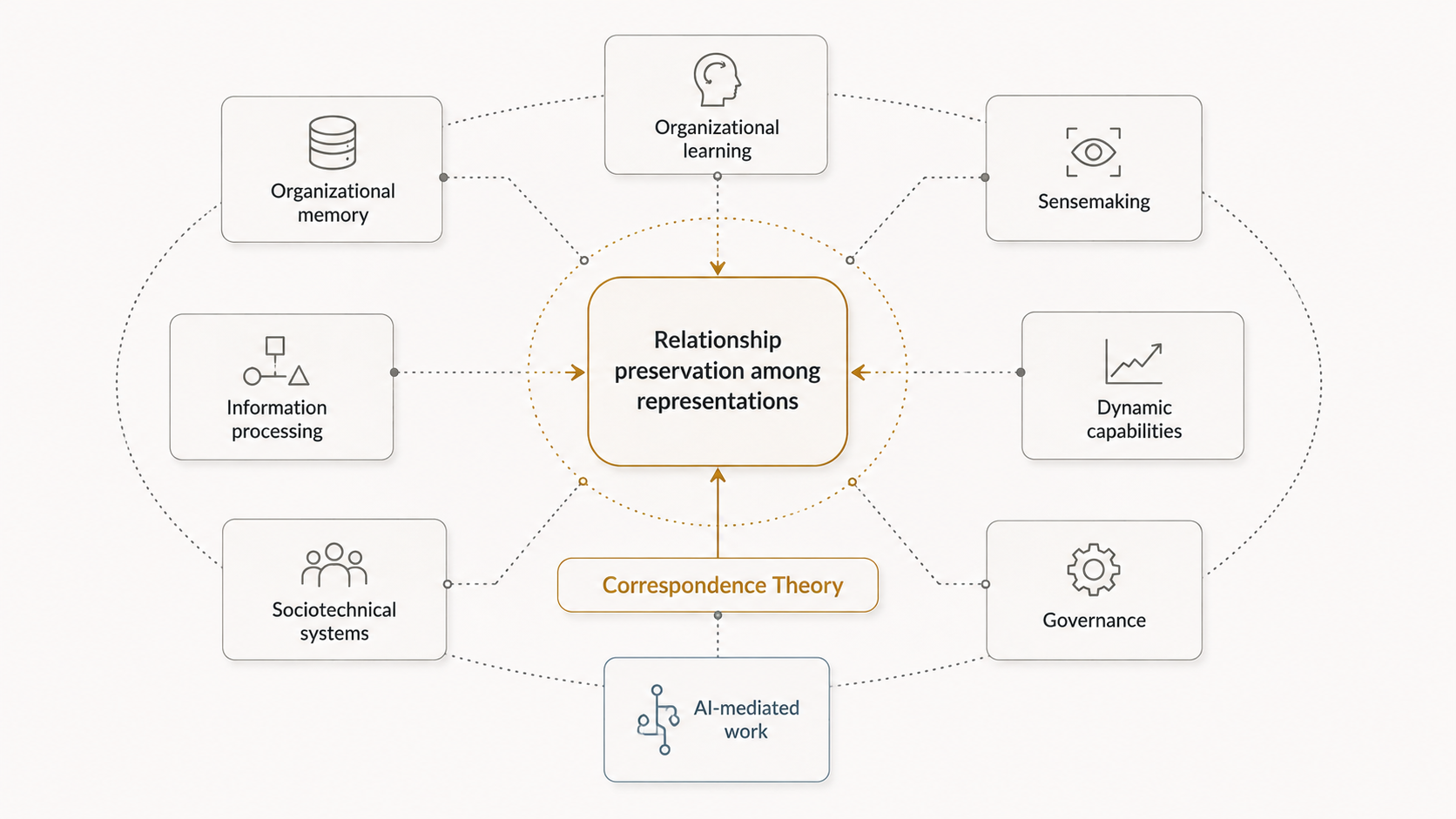
Correspondence Theory is built to explain that relationship-preservation problem. It does not replace adjacent theories. It defines a focal phenomenon that cuts across them: the preservation or degradation of meaningful relationships among representations. With the residual gap now visible, the book can name the theory's central construct.
Part II names the core construct and the condition it supports. Part I showed that organizations operate through Representation Networks. The next question is what property allows those networks to remain coherent as intent, evidence, authority, action, memory, and learning change.