
Authority Is Not Permission
Part III establishes the authority architecture of the Organizational Operating System. AI-native operation does not need merely faster action. It needs legitimate action: action whose source, scope, responsibility, and consequences can be traced.
Authority is one of the easiest ideas to blur in AI-native organizations. A system can have access. A workflow can have permission. An AI agent can be allowed to invoke a service. A user can click approve. None of those facts alone establishes organizational authority.
Authority is the legitimate organizational capacity to bind, admit, revise, reject, authorize, or act on behalf of the organization within a defined scope. It is not the same as capability. It is not the same as permission. It is not the same as confidence. It is not the same as a recommendation. It is not produced by technical access alone.
This distinction is central because AI systems are increasingly capable of producing outputs that resemble authoritative work. They can write recommendations, draft plans, prioritize issues, classify risk, initiate workflows, and prepare communications. But an AI-generated recommendation remains a recommendation. It becomes a decision only when an authorized human, body, or constituted organizational mechanism accepts responsibility for the commitment.
Executives need plain language here. A system may be allowed to prepare. It may be allowed to propose. It may even be allowed to execute within a defined delegation. But unless authority has been constituted and accepted, the system has not decided on behalf of the organization. Capability is not commitment.
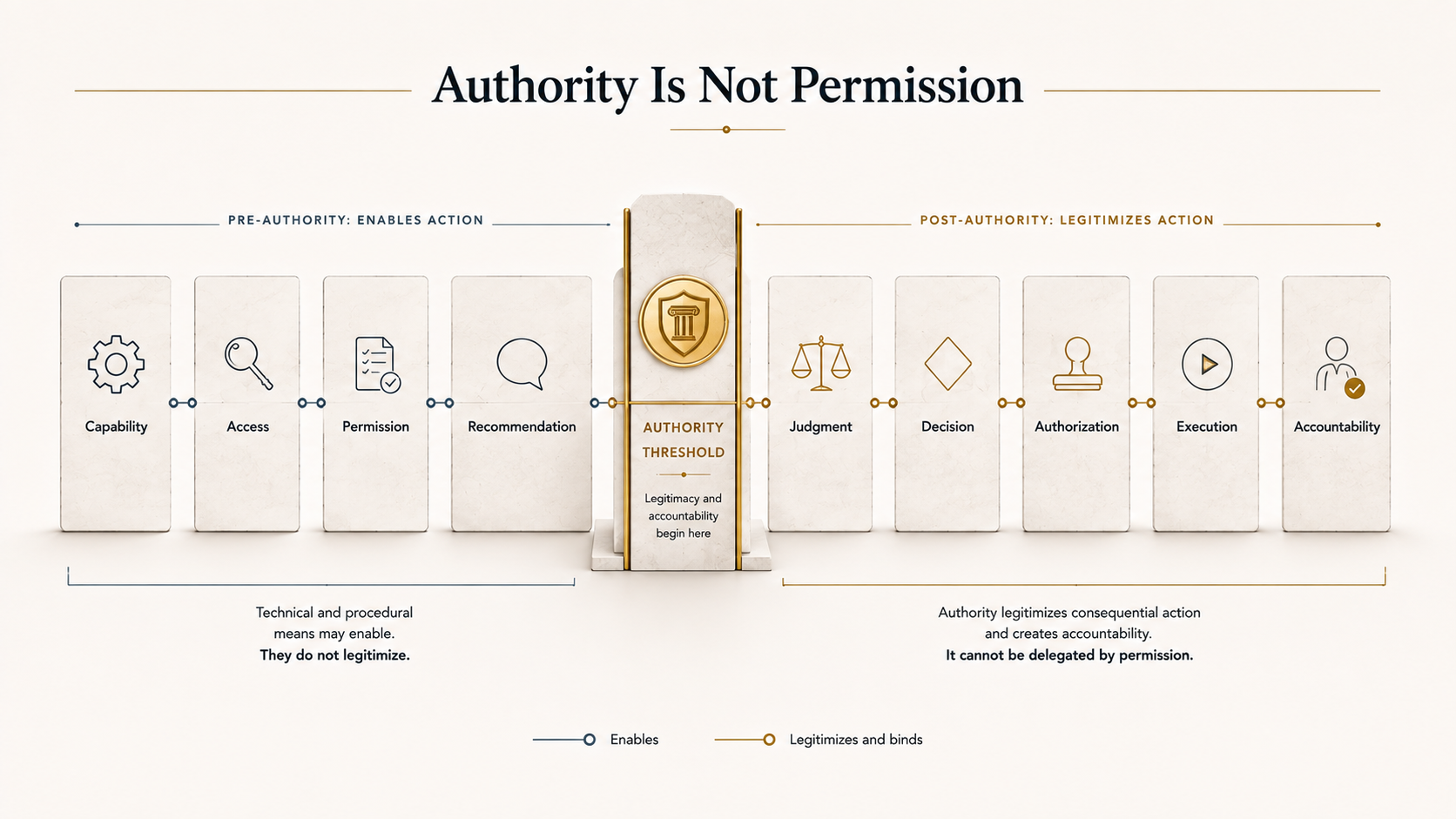
Its priority is the boundary between AI participation and human-held organizational authority.
The operating sequence should remain explicit:
```text Observation -> Inference -> Recommendation -> Judgment -> Decision -> Authorization -> Execution -> Evidence ```
AI may support observation, inference, recommendation, evidence synthesis, execution preparation, and bounded delegated action. Human and institutionally accountable authority must govern decision, authorization, revocation, escalation, and accountability. This is not a rejection of automation. It is the condition under which automation can be trusted as organizational action.
Governance must therefore make authority visible at the point of use. A projection should disclose whether it is informational, advisory, decision-ready, authorized, contested, stale, or superseded. A workflow should disclose what decision authorized it. An AI agent should operate within delegated scope and produce traces that can be inspected. A decision should preserve the rationale and evidence that made it legitimate.
Authority is the bridge from knowledge to action. But authority cannot depend on individual memory alone. It needs a durable but revisable architecture: an Organizational Constitution.