
The Organizational Constitution
The term Organizational Constitution can sound legalistic, but its role here is practical. The Organizational Constitution is the durable but revisable set of principles, authority rules, role definitions, representation rules, adaptation procedures, and repair mechanisms that make organizational action legitimate. It defines what the organization is, what it is trying to preserve, where authority originates, how authority is delegated, how action is attributed, what must remain contestable, and how change can occur without dissolving continuity.
In traditional organizations, much of this architecture is carried by hierarchy, policy, board governance, professional norms, operating routines, and institutional memory. AI-native operation stresses those arrangements because action can be prepared, coordinated, and partially executed by systems that are not moral or institutional members of the organization. The organization must therefore make explicit what may previously have been assumed.
The practical question is not whether every organization should write a formal constitution. The question is whether the organization has made its constitutional rules visible enough to guide AI-native work. Who can delegate authority to an AI agent? What must be escalated? What can be revised locally? What requires institutional review? What must remain contestable even when the system is confident?
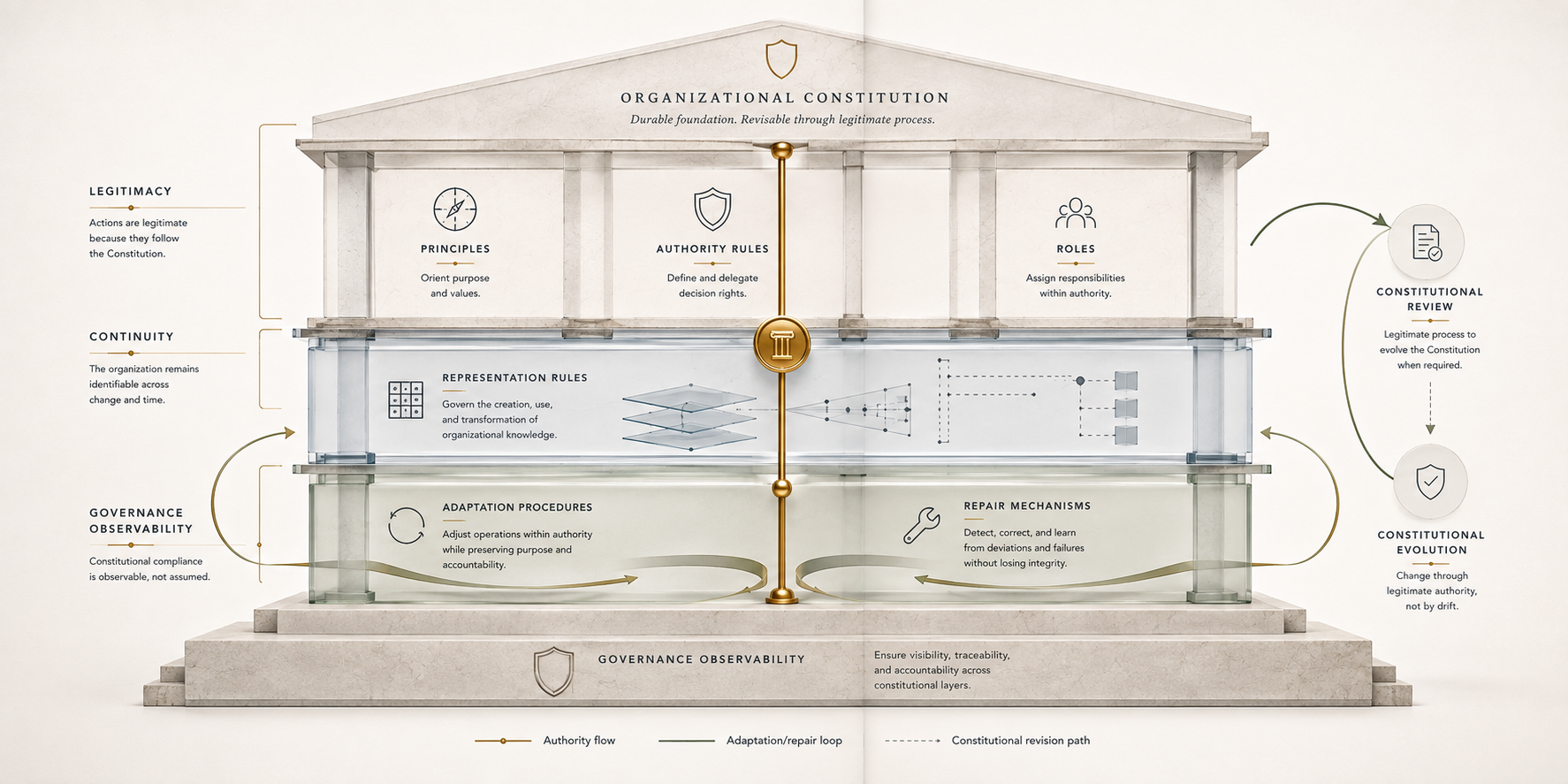
It makes governance visible as an operating structure rather than a compliance afterthought.
The Organizational Constitution does not freeze the organization. It makes change legitimate. It distinguishes runtime adaptation from constitutional evolution. Runtime adaptation adjusts work, representations, routines, priorities, or operating patterns within existing authority. Constitutional evolution revises the deeper rules under which future action becomes legitimate. The organization needs both. Without adaptation it becomes brittle. Without constitutional continuity it drifts.
This is why Governance should not be framed as a brake. Governance is the intrinsic operating mechanism that makes speed coherent, action legitimate, authority traceable, and adaptation accountable. It defines who can authorize what, what evidence is required, what must be recorded, what can be delegated, what must be escalated, what can be contested, what expires, and how repair occurs.
The Organizational Constitution is especially important for human-AI collaboration. It prevents AI capability from being mistaken for organizational authority. It also prevents human authority from becoming invisible behind automated processes. It makes accountability traceable in both directions: action can be traced back to authority, and authority can be held responsible for action.
Once the constitutional foundation exists, the question is no longer whether AI should participate. The question is how participation is bounded so that capability strengthens authority rather than quietly replacing it.