
Bounded Autonomy and Human-AI Participation
The goal of AI-native operation is not maximum autonomy. Maximum autonomy can become authority diffusion. The goal is legitimate autonomy: bounded, supervised, revocable, observable, and traceable participation in organizational work.
Human-AI Collaboration in this book means bounded participation among executives, employees, AI agents, workflows, software systems, and governance mechanisms under human-held organizational authority. Different participants contribute differently. Humans bring judgment, responsibility, ethical reasoning, contextual interpretation, and institutional authority. AI agents bring pattern recognition, synthesis, retrieval, comparison, coordination, and bounded execution support. Software systems preserve records and execute processes. Governance mechanisms define legitimacy and repair.
The operating system must make these roles visible. It should be clear when an AI agent is retrieving information, summarizing evidence, recommending an option, preparing a draft, monitoring execution, or performing a delegated action. It should also be clear who authorized the delegation, what constraints apply, when escalation is required, and how the action will be remembered.
Bounded autonomy is easiest to see in small operating decisions. A system might monitor routine exceptions and prepare corrective actions automatically. It might execute low-risk actions within a threshold. It might escalate anything that changes a customer commitment, budget exposure, safety condition, or strategic priority. The value is not that the system is autonomous in general. The value is that the organization knows exactly where autonomy ends.
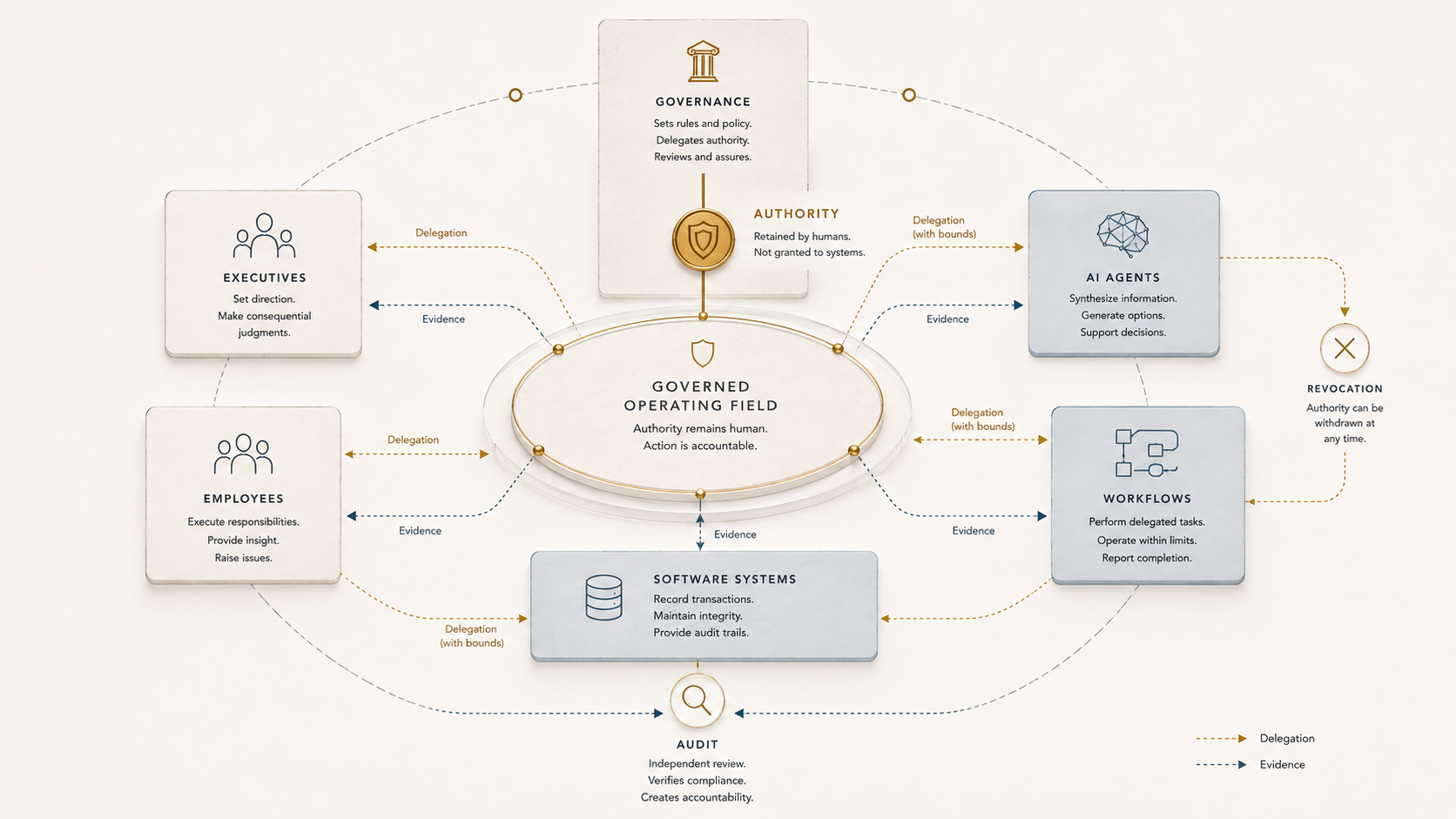
The figure asks leaders to inspect the whole participation system, not only the AI capability.
Bounded autonomy is not a concession to fear. It is how autonomy becomes organizationally useful. A system that can do many things but cannot disclose its authority basis, source, scope, confidence, evidence, and exception conditions is not a reliable participant in organizational action. A system with clear boundaries can be trusted more precisely because the organization knows what it is not allowed to do.
This chapter completes the constitutional layer. The organization now has governed knowledge and legitimate authority. But executives do not experience those architectures as diagrams. They experience them as attention, evidence, options, decisions, and consequences.