
From Organizational State to Executive Attention
Part IV makes the Organizational Operating System concrete. Governed knowledge and legitimate authority matter because they change what happens when leaders encounter the organization in motion.
Executive attention is often treated as a scarce human resource. That is true, but incomplete. In an Organizational Operating System, attention is also an output of the system. The organization decides, explicitly or implicitly, what becomes visible, what is prioritized, what is suppressed, what is escalated, and what is framed as actionable.
In AI-native operation, this becomes more consequential. AI can rank issues, summarize patterns, detect anomalies, and generate agendas. These functions can help leaders focus, but they can also capture attention if they hide uncertainty, omit dissent, overstate confidence, or detach issues from organizational intent. Attention is not neutral when it is mediated by representations.
Organizational State becomes executive attention when current commitments, evidence, risks, dependencies, changes, unresolved decisions, and outcomes are interpreted against intent and authority. A signal matters because it affects something the organization is trying to preserve or accomplish. A risk matters because it changes the conditions of action. A recommendation matters because it asks for judgment, decision, or authorization.
An executive agenda built this way feels different from a status report. It does not merely list what changed. It explains which changes matter because they threaten intent, expose uncertainty, alter a commitment, require authority, or create an opportunity to learn.
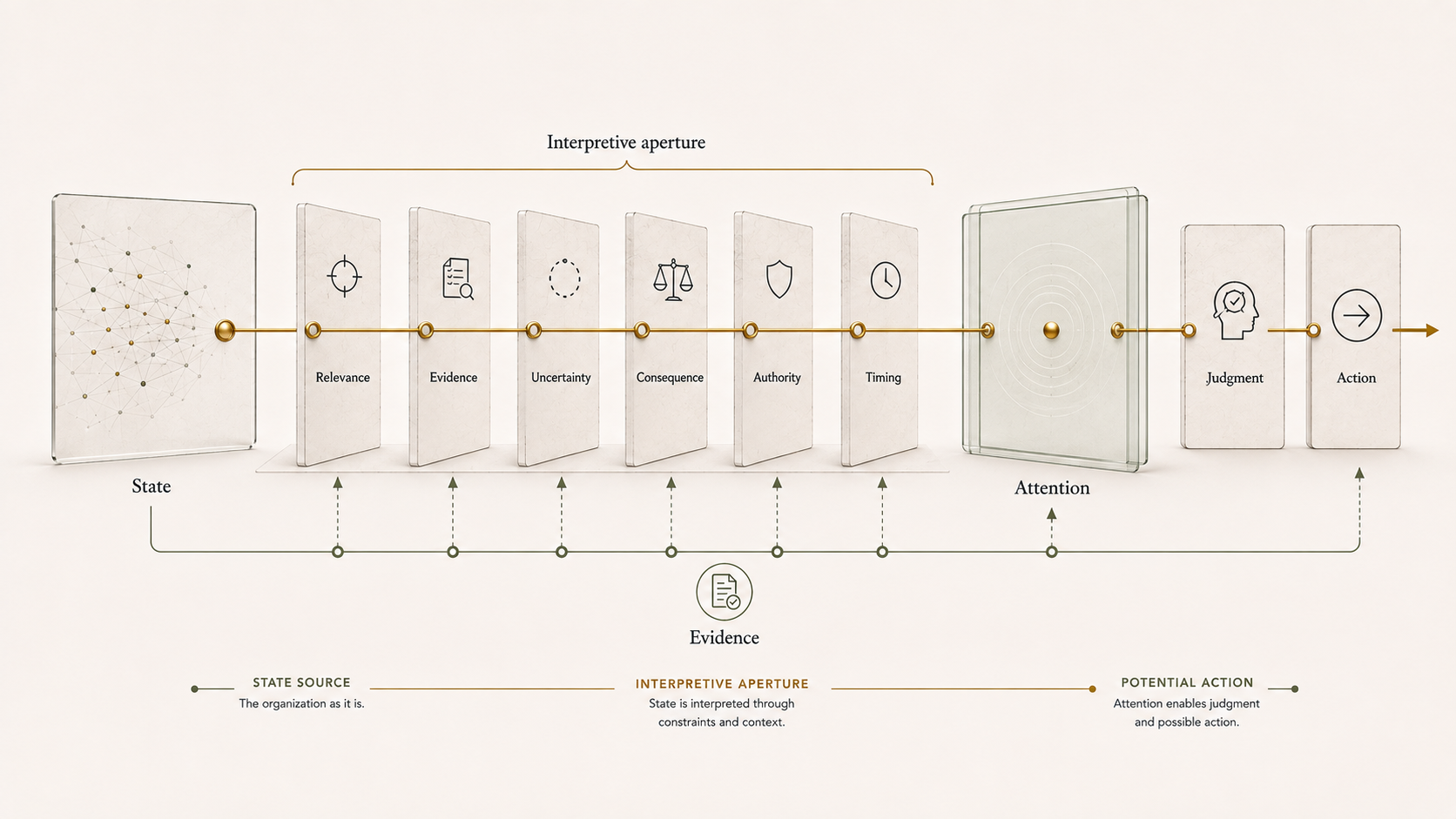
It makes clear that attention is not the same as visibility. Attention is state interpreted against consequence.
The chain is important because many executive systems stop too early. They present state and assume attention follows. Or they prioritize signals and assume relevance follows. But executives need to know why this issue now, why this interpretation, why this evidence, why this decision boundary, and why this authority condition.
Attention is therefore the gateway between the kernel and the operating episode. If the kernel preserves governed knowledge, the attention mechanism decides what part of that knowledge should enter executive judgment. Poor attention design creates noise, false urgency, hidden dependency, or missed consequence. Good attention design turns state into a question the executive is authorized and prepared to answer.
The next chapter shows the full operating episode in which that question is examined, challenged, and translated into accountable action.