Evidence, Learning, and Adaptation
Part V closes the loop. An Organizational Operating System is not complete until execution returns as evidence, evidence becomes learning, learning becomes adaptation, and adaptation preserves correspondence.
Organizations often confuse evidence with learning. Evidence is what returns from action: observations, outcomes, measures, traces, exceptions, feedback, and consequences. Learning is the governed revision of knowledge, assumptions, routines, representations, priorities, or intent based on interpreted evidence.
The distinction matters because evidence can accumulate without changing the organization. A dashboard can show results. A retrospective can record lessons. A system can preserve logs. An AI agent can summarize outcomes. None of this guarantees learning. Learning occurs when evidence is admitted, interpreted, contested where necessary, connected to prior assumptions, and used to revise the organization.
The executive question is therefore not only "What happened?" It is "What does what happened change?" Does the evidence confirm an assumption, weaken it, contradict it, or reveal that the organization was asking the wrong question? Without that interpretive step, even excellent evidence becomes another archive.
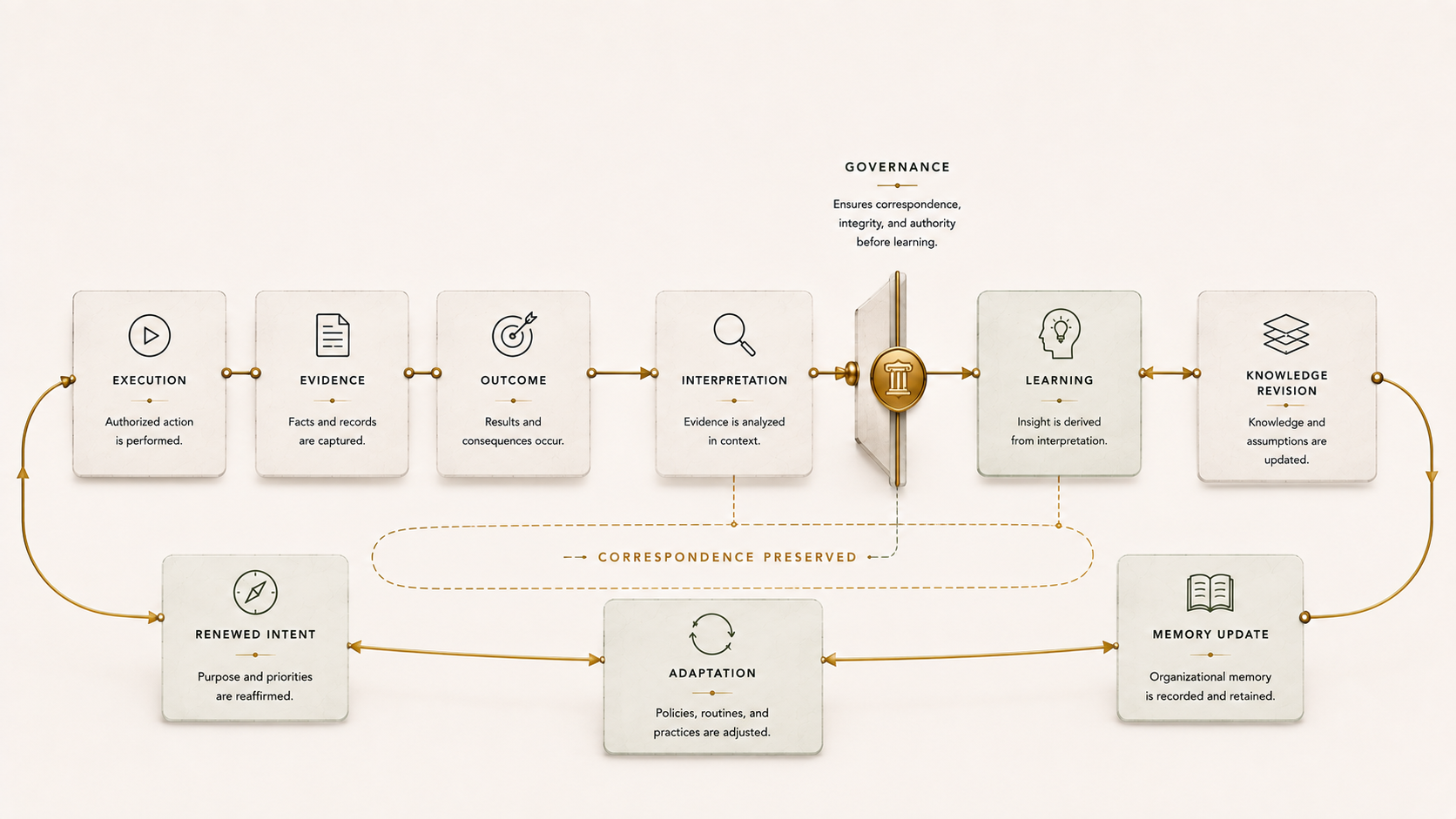
The loop is the test of whether the organization merely records experience or actually changes what it is prepared to rely on.
Adaptation is the next step. It is the adjustment of intent, governance, representation, routines, state interpretation, or execution based on learning. But adaptation is not automatically healthy. It can become drift if changes accumulate without correspondence to identity, authority, and intent. A learning organization is not simply one that changes. It is one that changes coherently.
The Organizational Operating System must therefore govern learning. It should ask what evidence supports the revision, what alternatives were considered, what authority can admit the learning, what existing knowledge is superseded, what memory should be retained, and what future projection should change. It should distinguish a local adjustment from a change in organizational doctrine.
This is the point at which the book's loop begins to close. The organization started with intent. It generated knowledge, attention, decision, execution, evidence, and memory. Now evidence returns to revise knowledge. If the loop is governed, the organization becomes more coherent through action. If the loop is not governed, action produces fragments.
The next chapter examines what happens when the loop breaks and why repair must be designed before failure arrives.