
From Decision to Execution Trace
A decision is not fully operational when it is spoken, written, clicked, or approved. It becomes operational when it is authorized, translated into execution, linked to responsibility, preserved with rationale, and returned as evidence.
This is one of the most important transitions in the Organizational Operating System. Many organizations lose coherence after the decision. The meeting ends. The summary circulates. A project begins. A workflow is updated. But the chain between recommendation, judgment, decision, authorization, execution, evidence, and memory may weaken. Later, the organization remembers that a choice was made but not what evidence supported it, what alternatives were rejected, what authority applied, or what outcome should be used to judge it.
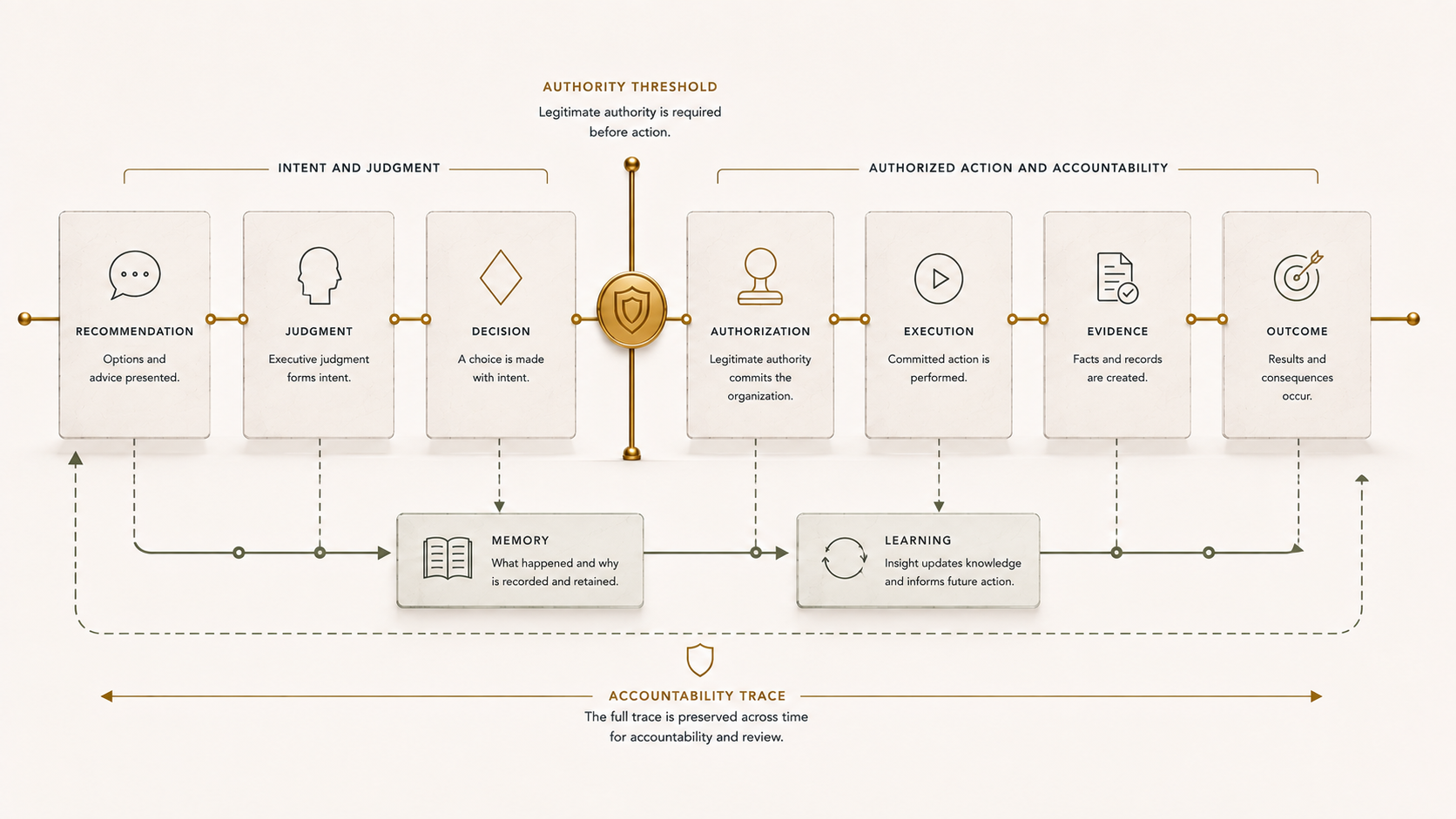
It makes clear that AI recommendations do not become decisions without accountable authority.
Execution traceability protects three things. It protects accountability by showing who authorized what and within what scope. It protects learning by connecting outcomes to the decisions and assumptions that produced them. It protects correspondence by keeping representations aligned as intent moves into work and work returns as evidence.
Traceability does not require every action to become bureaucratic. It requires consequential action to preserve the relationships needed for future interpretation. Low-risk delegated actions may need lightweight traces. Strategic commitments, authority changes, budget decisions, policy changes, and AI-agent delegations require richer traces. The operating system should scale traceability with consequence, reversibility, uncertainty, and authority.
This scaling matters. A routine routing decision should not carry the weight of a board-level commitment. But a decision that changes strategy, reallocates resources, delegates authority, or alters an external promise should leave enough trace for the organization to understand the judgment later. Traceability is not paperwork. It is future intelligibility.
This is where governance and memory meet. A decision trace becomes part of Organizational Memory, but it also changes Organizational State. The organization now has a commitment, an authorized action, a dependency, and an expectation. The question is whether the outcome will be interpreted and learned from, or whether the trace will become another forgotten record.