
The Executive Operating Experience
The Executive Operating Experience is where the Organizational Operating System becomes visible to leadership. It is not a dashboard, chatbot, briefing surface, or executive portal, although it may use all of those forms. It is a governed operating episode through which represented organizational reality is interpreted, prioritized, briefed, inspected, discussed, authorized, acted upon, remembered, and learned from.
The unit of analysis is the episode. An executive or authorized executive group enters the episode with an organizational state, an agenda, evidence, uncertainty, recommendations, authority boundaries, open questions, commitments, and memory from prior sessions. AI may help retrieve, summarize, compare, explain, challenge, and prepare. But AI does not hold the executive's authority.
The simplest way to imagine the episode is a boardroom conversation with memory. The organization enters the room with represented state, not just a slide deck. The executive can inspect evidence, ask what is uncertain, see prior commitments, distinguish recommendations from decisions, and authorize follow-up. When the session ends, the organization remembers more than notes. It remembers what changed.
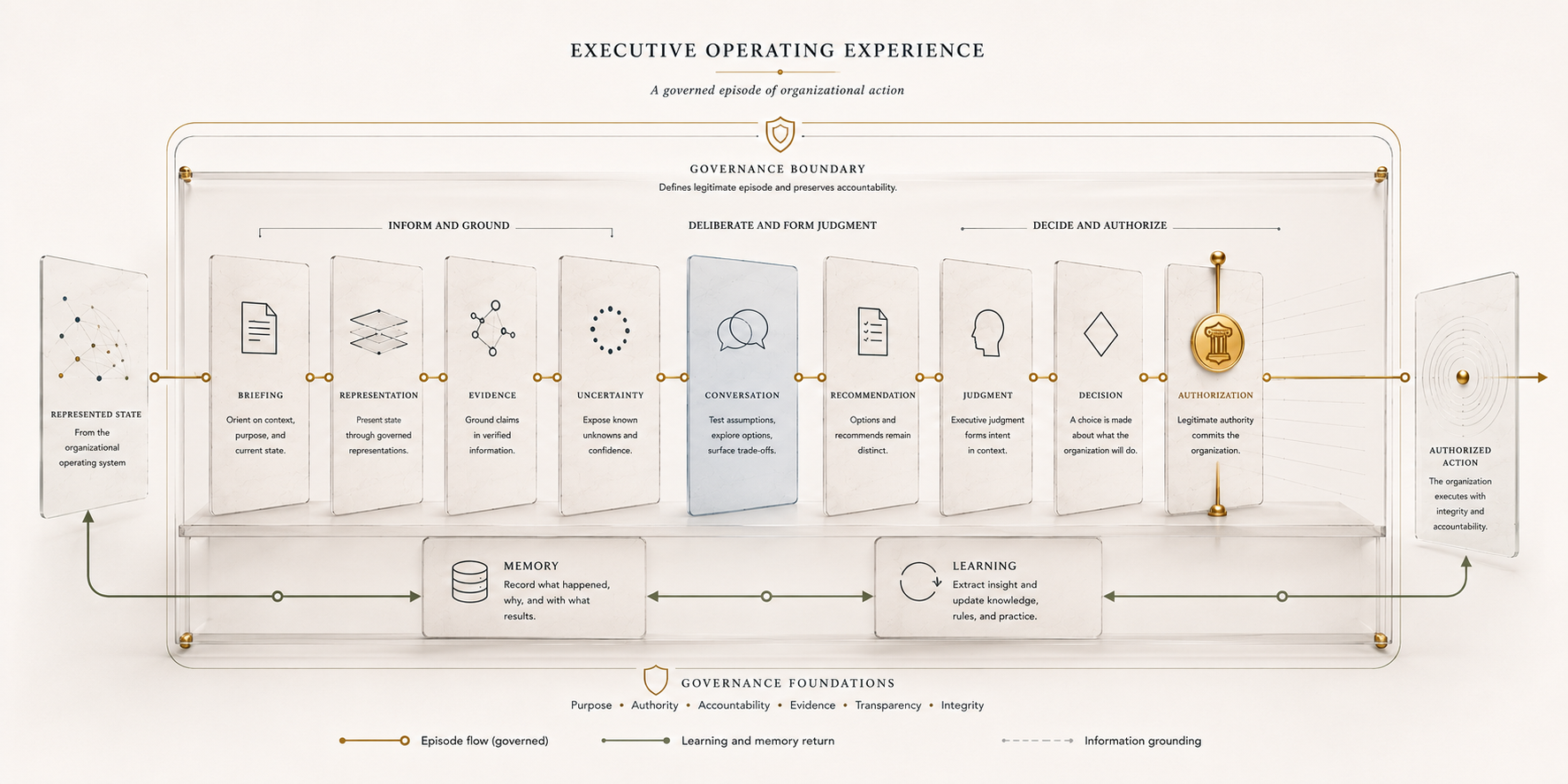
The figure matters because executive work is not a sequence of screens. It is a sequence of organizational acts.
The EOE matters because executive work is not only information consumption. It includes inquiry, clarification, challenge, comparison, dissent, prioritization, judgment, commitment, authorization, and follow-up. An executive may ask: What has changed? What matters today? What evidence supports this? What is uncertain? What options exist? What requires my authority? What happens if we defer? What should the organization remember?
In weak operating environments, these acts scatter across meetings, messages, documents, and memories. In an EOE, they are connected. Evidence remains visible. Uncertainty remains inspectable. Recommendations remain distinct from decisions. Decisions remain linked to authorization. Follow-up becomes organizational memory. Unresolved questions remain live rather than disappearing into chat history.
The experience is therefore conversational, but not merely conversational. Conversation matters because executives make sense through questions, challenges, interpretations, and commitments. But conversation must be grounded in governed representation. Without grounding, conversation becomes fluent ambiguity. Without authority, recommendation becomes pressure. Without memory, decision becomes isolated.
The executive operating episode is incomplete until the organization can remember what was authorized, why, by whom, from what evidence, with what expected outcome, and with what follow-up. That memory begins with the trace from decision to execution.