
AI can participate substantially in organizational work without automatically becoming organizational authority.
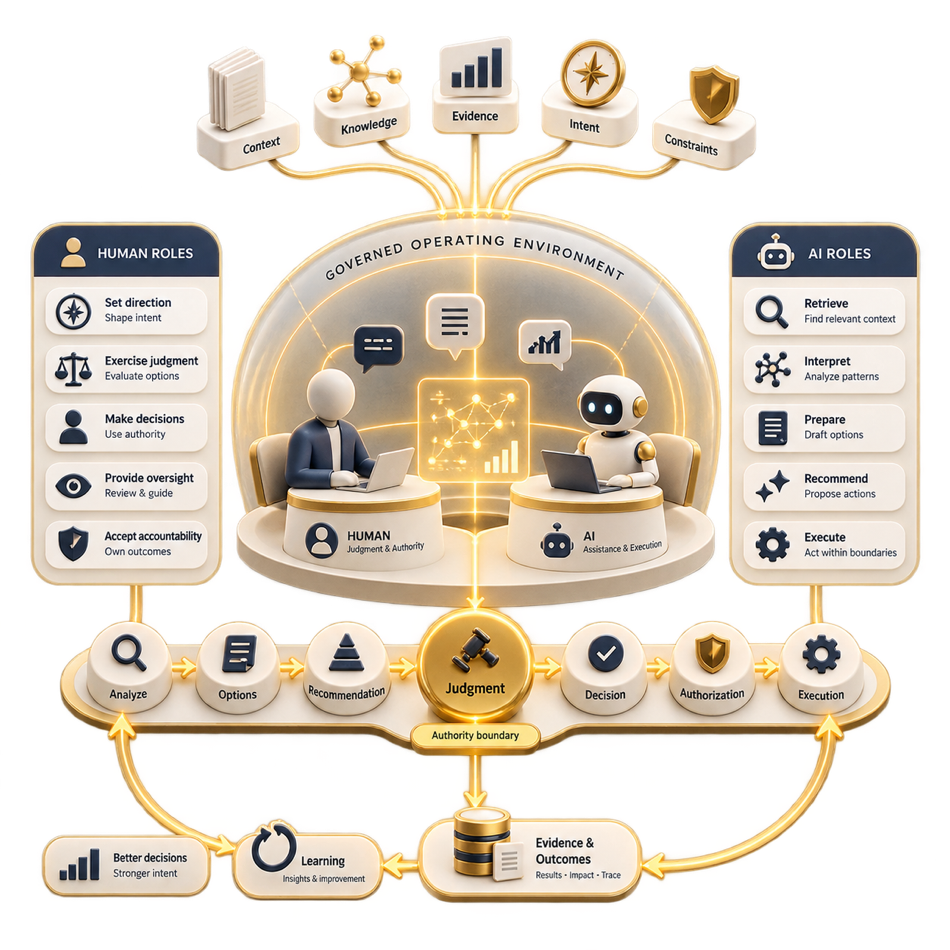
It can retrieve context, interpret patterns, surface evidence, draft options, prepare recommendations, and increasingly execute actions within defined boundaries. Used well, these capabilities can reduce the effort required to understand what is happening and help an organization act with greater speed and consistency.
The question is therefore not whether AI should participate.
It is how people and AI can participate together without making authority, judgment, and accountability disappear.
What should AI be able to do?
AI does not need to be limited to answering questions or generating text.
It can help an organization interpret its operating context, identify relevant evidence, prepare alternatives, challenge assumptions, recommend actions, and carry out work where the organization has established appropriate boundaries.
As those capabilities improve, the useful scope of AI participation can expand.
But capability alone does not determine what AI should be allowed to do. The organization must also consider the intent being served, the authority under which an action occurs, the consequences of getting it wrong, the evidence available, and the accountability that follows.
This is what makes AI participation an organizational question rather than simply a technology question.
Where does human judgment remain necessary?
Not every action requires human approval.
Routine actions may operate within established authority and constraints. AI may prepare decisions that humans authorize. In other situations, AI may execute autonomously within clearly governed boundaries.
Human judgment becomes particularly important when circumstances are ambiguous, consequences are significant, competing interests must be balanced, authority must be exercised, or the organization needs to take responsibility for a choice.
The objective is not to place a human checkpoint in front of every AI action.
It is to make clear where judgment is required, who holds authority, what may be delegated, and when escalation is necessary.
What does governed participation mean?
Governed participation means that people and AI operate within an organizational context that remains intelligible.
The organization can understand what intent an action serves, what knowledge and evidence informed it, what authority permitted it, what decision was made, what happened as a result, and who remains accountable.
This creates room for autonomy without requiring the organization to surrender visibility.
As AI becomes more capable, the boundary between human and AI work will continue to move. A governed operating model does not need to fix that boundary permanently. It needs to make the boundary explicit enough that it can evolve deliberately.
Correspondia's position is therefore neither fear of AI nor autonomous-management hype.
The goal is governed participation: increasing what people and AI can accomplish together while preserving the organizational intelligence needed to understand and govern what they do.
- How does authority remain visible as AI becomes more autonomous?Explore how decision rights, delegation, authorization, and accountability remain explicit as AI takes on more organizational work.
- How does AI know what intent it is serving?See how persistent organizational intent gives people and AI a shared reference for decisions, actions, constraints, and changing circumstances.
- What happens when AI begins to act?Explore how execution remains connected to decisions and authority, and how actions produce evidence the organization can learn from.
- How does the operating system support governed human + AI participation?See how intent, knowledge, authority, decisions, execution, evidence, and learning remain connected as people and AI operate together.