
A recommendation is not a decision.
AI may prepare a recommendation. A team may propose a course of action. A system may surface evidence. None of these becomes an organizational decision simply because it exists.
A decision becomes organizationally meaningful when judgment is exercised under appropriate authority—and when the organization preserves enough context to understand what was decided, why, by whom, under what authority, and with what constraints.
When does a recommendation become a decision?
Recommendations create possibilities.
They may bring together evidence, identify alternatives, expose risks, or suggest what should happen next. As AI becomes more capable, organizations will be able to generate more recommendations, more quickly, and with increasingly sophisticated reasoning.
But generating a recommendation and accepting responsibility for a course of action are different organizational acts.
A decision occurs when the appropriate authority exercises judgment and commits the organization to a choice.
That distinction matters because the organization must later be able to understand why action occurred—not merely reconstruct which recommendation happened to precede it.
What should remain connected to a decision?
A decision should not survive merely as a sentence in meeting notes, a message, or a status field.
Its organizational meaning comes from its relationships.
What intent was the decision meant to serve? What evidence informed it? What alternatives were considered? Who had authority? What constraints applied? What action was expected to follow?
Preserving those relationships creates a decision record that remains meaningful after the moment of decision has passed.
This becomes particularly important when AI participates in preparation and reasoning. The organization should be able to distinguish between what AI recommended and what the organization actually decided.
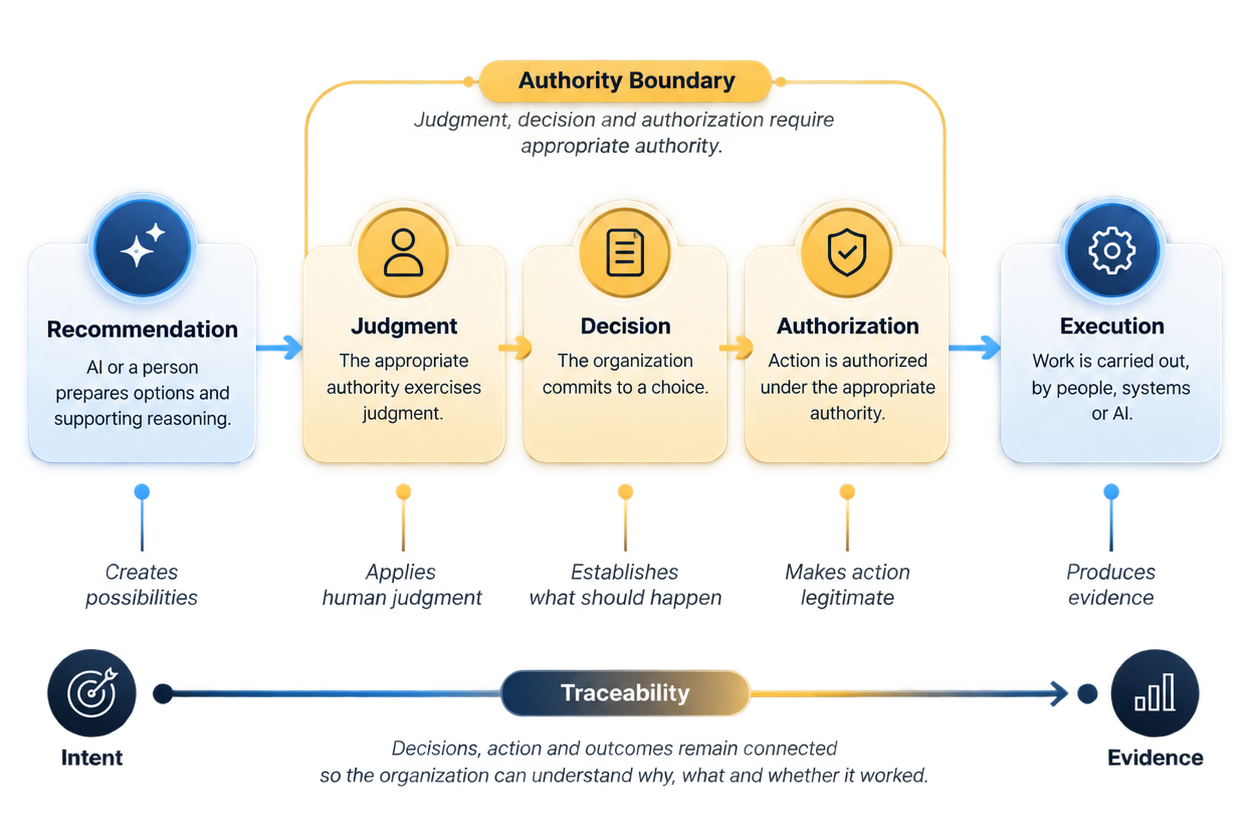
How is authorization different from a decision?
A decision establishes what should happen.
Authorization establishes that action may proceed under the appropriate authority.
Sometimes the same person or organizational mechanism performs both acts. In other situations they are deliberately separated.
A leadership team may decide on a direction while another role authorizes expenditure. An AI system may recommend an action while a person authorizes execution. A previously authorized policy may allow an automated system to execute certain decisions without requesting approval each time.
The important point is not that every action requires another approval.
It is that the organization can understand under what authority the action became legitimate.
What happens after authorization?
Authorization should not be the end of the trace.
Once action begins, execution should remain connected to the decision that caused it. Evidence should return from that execution. Outcomes should be interpreted against what the decision was intended to achieve.
That creates continuity:
Intent → Recommendation → Judgment → Decision → Authorization → Execution → Evidence → Learning
Without that continuity, organizations may become very good at making and executing decisions while gradually losing the ability to understand why those decisions were made and whether they worked.
- Where does the authority to decide come from?Explore how decision rights, delegation, authorization, and accountability remain explicit as work moves across people, systems, and AI.
- How does a decision remain connected to intent?See how persistent organizational intent provides the context for understanding why a decision exists and what it is meant to achieve.
- What happens once a decision becomes action?Explore how authorized decisions become execution, produce evidence, reveal outcomes, and contribute to organizational learning.
- How can AI participate without becoming the authority?See how AI can prepare, recommend, and act within governed boundaries while judgment and accountability remain explicit where required.